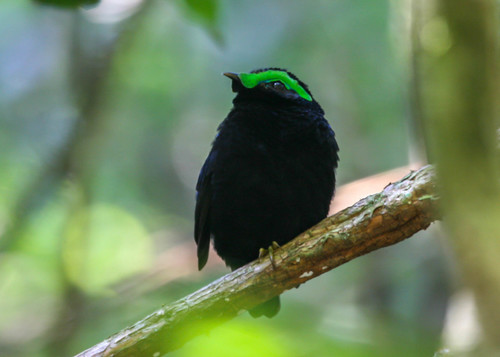
About Philepitta castanea (Statius Muller, 1776)
The velvet asity (Philepitta castanea) has a recorded minimum longevity of approximately 7 years. It is a small, plump bird ranging from 14 to 16.5 centimeters in total body length, with an average weight of around 38.9 grams. Its average tail length measures about 42.5 millimeters and its average wing length measures about 82.1 millimeters; both the tail and wings are short and rounded. The narrow bill is slightly curved downward, with an average length of 18.1 millimeters and an average width of 6.0 millimeters. The legs of the velvet asity are relatively short. Due to its poor wing structure and chunky body build, this species is not suited for strong or sustained flight. Instead, it is well adapted to foraging from perches, and its short, narrow bill lets it easily pick fruit while remaining perched. The velvet asity is endemic to the island of Madagascar, where it occurs along the eastern side and in the northwestern corner of the island, ranging from sea level up to 1,800 meters in elevation. It is commonly found in Ranomafana National Park in southeastern Madagascar, and in the mountainous rainforest of the Masola Peninsula in northwestern Madagascar. This species inhabits subtropical or tropical moist lowland forests, including both primary and secondary rainforests, as well as forested areas adjacent to degraded rainforests affected by human disturbance. It tends to prefer sites with an open understory, especially along valley sides and valley bottoms. While it has been recorded at both low and mid elevations, it is most common between 600 and 1,400 meters. It is uncommon at elevations below 400 meters and above 1,600 meters, and it does not occur in montane sclerophyllous forests.

