About Philemon citreogularis (Gould, 1837)
This species is commonly known as the little friarbird, with the scientific name Philemon citreogularis (Gould, 1837).
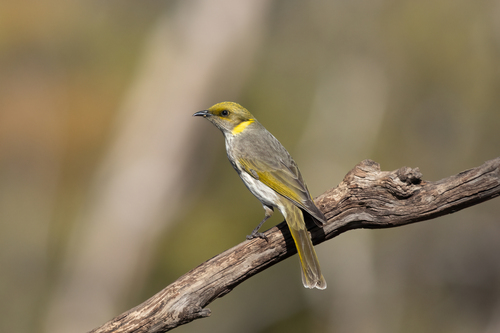
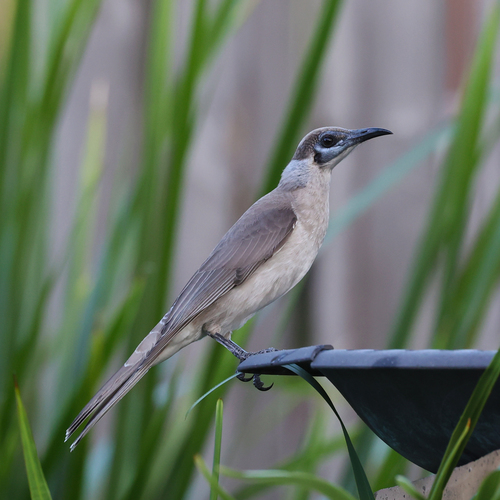
Adults of the little friarbird measure between 25 and 30 centimetres (9.8–11.8 in) in length, with an average length of 27 centimetres (11 in) and an average weight of 67 grams (2.4 oz). While males and females are very similar in appearance, males are larger. This species can be easily told apart from other friarbirds by its lack of a casque, the prominent ridge or bump found on the beaks of other species. Another key identifying feature is bare blue skin under the eye that widens across the cheek; this bare skin can range in tone from grey to black. Dark feathers grow both above and below this patch of bare skin.
The top of the head and the upper body are dark grey-brown, with a dull white fringe on the nape that extends around to form a wide patch on the side of the neck. Fine silky white feathers cover the under chin, and silvery white streaks run down the breast, blending into the pale grey of the species' underbody. The little friarbird has a curved black bill, dark brown eyes, and bluish black legs. Its flight is characterized by shallow, quivering wing beats. When spread, the tail is clearly square-cut, with slight pale tips on the tail feathers.
The little friarbird occurs most predominantly in northern Australia, and makes seasonal movements to southeastern Australia. Its range extends from the Broome district in Western Australia, through the Kimberley region, into the northern part of the Northern Territory. It has been recorded across most of Queensland, reaching as far inland as Mount Isa and Opalton. In summer, it spreads throughout southeastern Australia, living in New South Wales, Victoria, South Australia, and the Australian Capital Territory. It has been sighted along the Murray River and throughout the Riverina region of New South Wales. In Victoria, it is found in the north-central area of the state, and near large bodies of water such as Hattah Lakes. In South Australia, sightings reach as far downstream as Morgan on the Murray River. The species is also found in southern Papua New Guinea, and on multiple islands adjacent to Australia.
Little friarbirds are found most often around water bodies. They occur in swamp woodlands, mangroves, shrub communities, open forests, and woodlands dominated by Eucalyptus trees. During years with good flowering, they also live in orchards, vineyards, and gardens. They may sometimes occupy arid zones, but only in areas where water bodies extend well into the region.