About Philemon buceroides (Swainson, 1838)
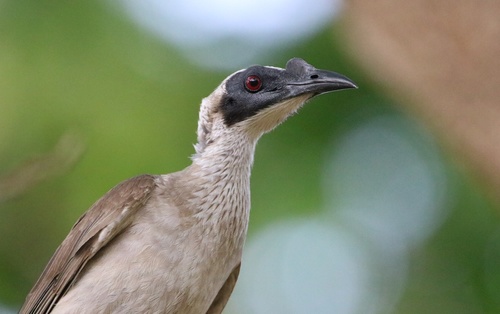
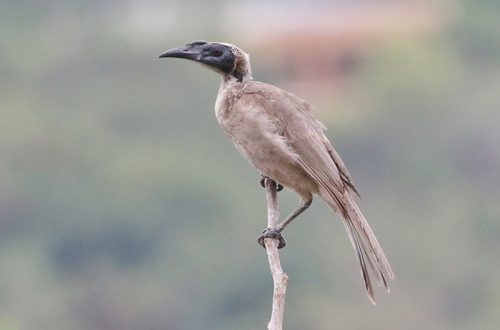
Philemon buceroides, commonly called the helmeted friarbird, has a dark gray face and red eyes. Its plumage is gray-brown overall, fading to white toward the chest. The chest, which has spots, becomes increasingly darker in tint toward the bird’s feet. This species measures between 32 and 36 centimeters in length. Males weigh 127 to 179 grams, while females weigh 92 to 112 grams. The largest of the four helmeted friarbird subspecies found in Australia has an average male length of 38 cm. The helmeted friarbird is most abundant along the Northern Territory coasts of Australia and in Indonesia. Preferred habitat varies by subspecies, but the species is mainly found in subtropical or tropical dry forests, lowland forests, and mangrove forests. When building nests, helmeted friarbirds typically use bark, leaves, and stems to make a sturdy structure. They also add sticks for extra support and grass for comfort. They tend to place their nests high in trees close to a body of water, to avoid predation or harm. The helmeted friarbird has a varied diet. Its main food sources are nectar, fruits, and seeds. It will occasionally eat invertebrates, and very rarely eats lizards. The core makeup of its diet varies depending on the bird’s location. They often gather into feeding groups of 10 to 30 individuals around flowering trees and shrubs.