About Philadelphus lewisii Pursh
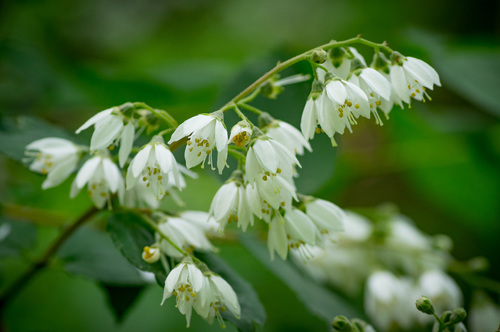
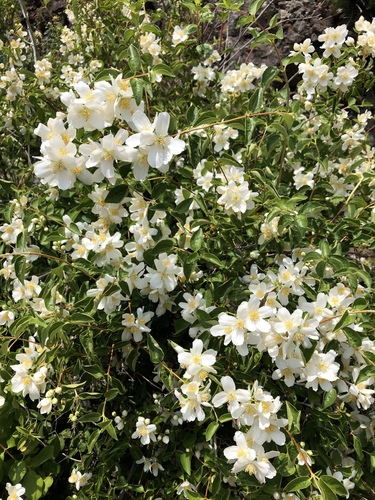
This perennial, rounded shrub reaches 1.5 to 3 meters (5 to 10 feet) in height. It produces long stems that are red when new, fading to gray with age, and its bark shreds into small flakes. Its oppositely arranged leaves are usually oval, 3 to 5 centimeters (1+1⁄4 to 2 inches) long, with edges that are either smooth or serrated. They are light green and have a rough texture, and their size varies across individual plants. Flowers grow in clusters at the ends of long stems, each with four white petals up to 4 centimeters (1+1⁄2 inches) long and numerous yellow stamens. When at peak bloom, the entire plant is covered in a mass of blossoms. The flowers have a heavy, sweet scent similar to orange blossoms with a faint hint of pineapple. The fruit is a small, hard capsule around 1 centimeter long, with woody pointed wings and many brown seeds inside. Drought stunts fruit development and prevents the production of viable seeds. The plant is somewhat similar in appearance to serviceberry. Lewis' mock-orange (Philadelphus lewisii Pursh) grows from northwestern California in the Sierra Nevada, north through the Pacific Northwest to southern British Columbia, and east to Idaho and Montana. In the Cascade Range it occurs from sea level up to 2,100 meters (7,000 feet), while in the Sierra Nevada it grows between 300 and 1,520 meters (1,000 to 5,000 feet). While tolerant of moderate shade, it prefers full sun. It is common in open coniferous forests and on forest edges; in drier parts of the Pacific Northwest it grows mostly in wetter, riparian areas. It can also be found in chaparral and seral communities. It grows on well-drained, moist sites, tolerates rocky soil, and is hardy in USDA zones 3 to 9. Lewis' mock-orange foliage is moderately important as winter forage for elk and deer in British Columbia, Idaho, and Montana. A 1957 study in Montana found it made up 2% of mule deer winter diets, and only a trace portion of summer diets. Quail and squirrels eat the plant's seeds. Dense stands of this shrub provide quality thermal and security cover for wildlife. Philadelphus lewisii can spread both vegetatively and from seed, and forms seedbanks in the top 5.1 centimeters (2 inches) of soil. This shrub is native to relatively arid regions of the American West that experience frequent wildfires, so it is well adapted to fire. While wildfires typically kill all above-ground growth of the plant, it resprouts vigorously from rhizomes and root crowns after fire. A 1971 study found that mock-orange regrew to 50% of its previous diameter and height within the first growing season after fire. The study also recorded an average of 28.9 to 38.0 sprouts per plant after fire, compared to only 0.6 to 1.5 sprouts per plant before fire. Palatability of Lewis' mock-orange for Rocky Mountain elk is much higher after fire: 36.3% of twigs are browsed post-fire, compared to only 1.3% of twigs on adjacent unburned sites. In cultivation, Lewis' mock-orange prefers full sun to partial sun. It is drought-tolerant, grows in poor soils, and is suitable for xeriscaping. It adds showy blossoms and pleasant fruity fragrance to landscape plantings. The cultivated hybrid Philadelphus lewisii 'Waterton' (Waterton Mockorange) was developed by the Alberta Horticultural Research Station in Brooks, Alberta, Canada. It grows 1.2 to 1.8 meters (4 to 6 feet) tall. It is named for Augustus Griffin, who first recorded this plant growing in what is now Waterton Lakes National Park, Canada, in 1933.