About Philadelphus coronarius L.
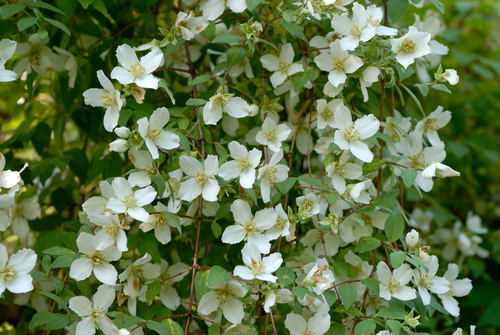
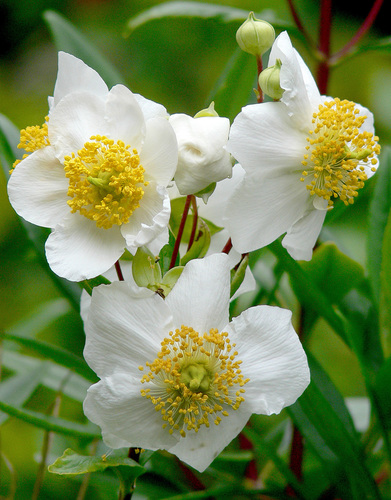
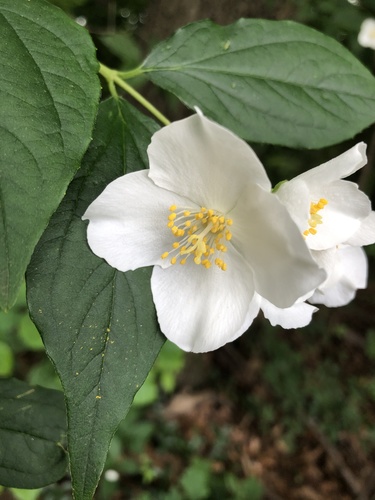
Philadelphus coronarius L. is a deciduous shrub that grows to 3 meters (10 feet) tall and 2.5 meters (8 feet) wide. It has toothed leaves and bowl-shaped white flowers with prominent stamens. Wild-type plants produce abundant, very fragrant blooms, while cultivars typically have less fragrant flowers. It resembles dogwood (common name for Cornus species in the family Cornaceae) but is not closely related to these plants. It can be distinguished from other species in the Philadelphus genus by its strong fragrance, glabrous calyx, and leaf lower surfaces that are only partially pubescent along the nerves, rather than pubescent across the entire surface. Its specific epithet coronarius means "used for garlands". This plant is native to Turkey, the Transcaucasus, and the North Caucasus. It has spread to large areas of Europe, as well as Eastern Canada (Quebec and half of Ontario) and the United States, ranging from the Atlantic Coast to Georgia, across the South and Midwest. In 1562, Ogier Ghiselin de Busbecq introduced this plant from Turkey to Europe when he returned to the Holy Roman Empire after his ambassadorship to the sultan. Around the same period, lilac was introduced from the same general Middle Eastern region; confusingly, both plants were called syringa (meaning pan pipe or pipe). This shared name came not from similar flowers, but because both plants had hollow stems that Turks used to make pipes. As a result, pre-Linnaean authors referred to Philadelphus species as Syrigna alba. When Carolus Clusius illustrated this plant in his 1576 work Libri Picturati, he used the name Syrigna flore alba; he also created the name Frutex coronarius, which only he used in his 1601 work Rariorum plantarum historia. The plant was already grown in Austria and Hungary by the 16th century. Clusius found it growing in a Belgian garden, and later introduced the plant to Spain. In England, John Gerard wrote that he grew this characteristically fragrant plant in profusion in his 1597 Herball. He used the name Syrigna alba, which led some later writers to mistakenly think he was describing white-flowered lilacs, when he was actually referring to this mock orange. Philadelphus coronarius is a sweetly scented shrub with white blossoms, suited to cultivation in temperate climates as an ornamental garden plant. It blooms from April to May in the American South, and blooms in the same April to May window, potentially later, in the temperate Midwest. It tolerates cold, heat, and drought, though Hansen considered it too winter-tender for South Dakota, where the shrub dies back to the ground during cold winters. It can be easily propagated by cuttings, division, and self-sown seedlings. Many named cultivars exist, and it interbreeds readily with other Philadelphus species. Lemoine Nursery of Nice, France has introduced a number of hybrids between P. coronarius and P. microphyllus. Two cultivars have earned the Royal Horticultural Society's Award of Garden Merit: P. coronarius 'Aureus' and P. coronarius 'Variegatus'. 16th century botanist John Gerard found the plant's fragrance too intense, reporting that it disturbed his sleep. E. A. Bowles claimed the plant triggers allergic reactions with hay fever-like symptoms. The flowers of this mock orange, which have a scent similar to orange blossoms, have been used in modern perfumery, though the essential oil is typically synthesized today. In Europe, it was once marketed as "oil of syringa" or "oil of false jasmine", and was used to make a cheap pomade called "orange-blossom pomade" in Southern France. Today, it is sometimes suggested for use in potpourri. According to English botanical painter Alice Margaret Coats, blossom tea can be made from this plant, and current literature records that this tea use occurs locally in the Baltic countries of Latvia and Estonia. Coats also noted that the plant's leaves can add a cucumber-like flavor to beverages.