About Phidippus audax (Hentz, 1845)
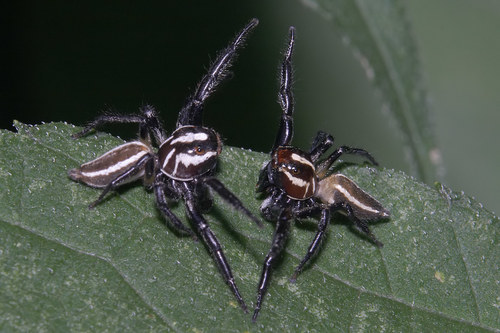
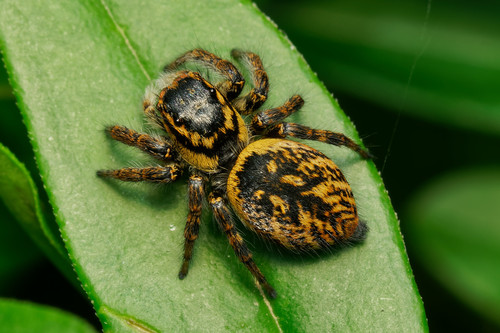
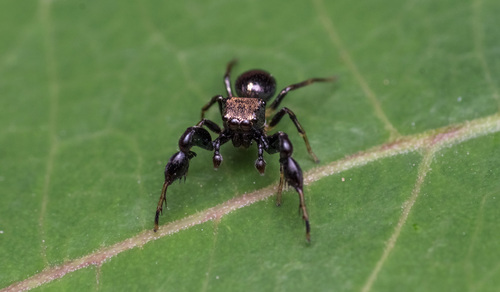
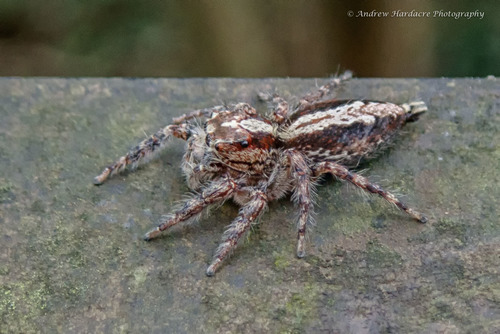
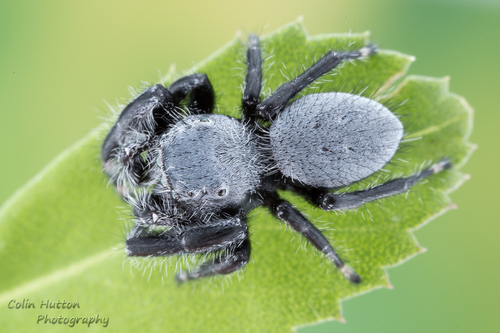
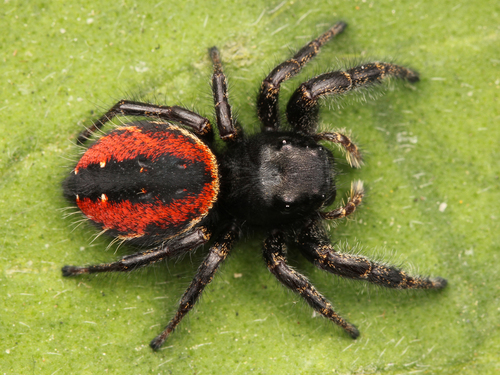
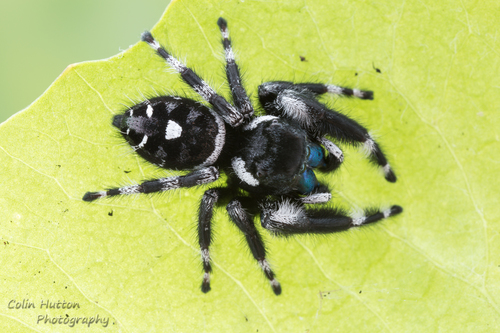
Phidippus audax (Hentz, 1845), commonly called the bold jumping spider or bold jumper, can be identified by the following size and physical traits, following research from Edwards 2004. Adult female bold jumpers have a body length ranging from 8–15 mm, while smaller adult males range from 6–13 mm. The species is most often distinguished by a large, typically triangular white spot in the center of the abdomen, with two smaller spots located below this central spot. The closely related Phidippus regius has a similar abdominal pattern, and the two species share overlapping range in the southeastern United States. However, the posterior light spots of P. audax are usually more linear, while they are more oval in P. regius. Additionally, P. audax has pairs of matte black patches on the abdomen that are not present on P. regius. Bold jumpers are recognizable by their powerful jumping legs. Their legs and pedipalps have white banding, and fringes on these structures are more prominent in males. In females, the fourth pair of legs is typically the longest, while in males the first pair of legs is the longest. Their chelicerae are iridescent green. Adult males have far more striking chelicerae and markings than females, and they also have tufts of hair covering their eyes. Markings on spiderlings are usually orange, and turn white as the spider reaches maturity. Size and coloration of bold jumpers also varies significantly between different populations. Bold jumping spiders are native to North America, and are widespread across the United States, southern Canada, and northern Mexico. They are thought to have been introduced to arid regions of the southwest United States, where they only survive in areas with irrigation. They have also been introduced to Hawaii, the Nicobar Islands, the Azores, and the Netherlands. Bold jumpers prefer temperate climates, and can be found in a wide variety of terrestrial habitats including grasslands, chaparrals, open woodlands, and agricultural fields. It is one of the most common spider species within its native range, and often lives in close proximity to humans. It is frequently seen in gardens, and inside homes, barns, and garages. Jumping spiders need daylight to see, so they are most likely to be observed during the day. At night, bold jumpers shelter in sac-like silk retreats near their hunting grounds. They spin these retreats in concealed locations, most often on vegetation and under stones and bark. The retreats protect the spider, and are often reused repeatedly. Overwintering bold jumpers use similar silk shelters. Bold jumpers are among the most abundant spiders found in agricultural crops, where they hunt many types of crop pests. In parts of the species' southern range, they can also be found in grassy areas near bodies of water. Around 10 days after oviposition, spiderlings hatch inside the egg-sac. After hatching, they complete their first molt within the egg-sac, and do not emerge for another 10–14 days. They emerge as free-living second instars that are already capable of hunting. After emerging, spiderlings usually disperse via ballooning. Bold jumpers continue maturing through 6 to 7 additional instars. Every instar except the first completes its molt inside a specialized molting web; the spider encloses itself in this web to shed its exoskeleton, and emerges larger after each molt. Females usually require one extra instar to reach maturity compared to males, and reach maturity a few weeks later, likely because they grow larger and need more development time. On average, bold jumpers take approximately 9 months from oviposition to reach sexual maturity. In the northern part of the species' range, bold jumpers overwinter as immatures. To prepare for overwintering, these spiders envelop themselves in sac-like silk shelters hidden under rocks and bark. These shelters conceal and protect the spider. As temperatures drop, spiders enter a state of dormancy called diapause, during which their development stops. Spiders emerge in the spring and complete their final molts, and are typically ready to mate by late spring or early summer. In a laboratory study, the average lifespan of bold jumpers was just over one year, with females living a couple of months longer than males. After completing their final molts, bold jumpers are fully developed and ready to mate. A male prepares for mating by constructing a small silk mat, releasing sperm from his testes onto the mat, then drawing the sperm into each of his two emboli. The male then begins searching for a female. Females emit pheromones in their silk draglines, which males can detect via contact with chemoreceptors in their pedipalps. This gives the male information about the female's reproductive status and helps guide his search. Because males mature earlier than females, males often find an immature female's nest while searching for a mate. To increase his chance of mating, the male may build his own nest nearby and wait until the female matures to get a mating opportunity. When he encounters a sexually mature female, he begins a courtship display. During this display, he raises his front legs, flicks his forelegs, and shakes his pedipalps while moving laterally along a zigzag path. He occasionally pauses in a pose with his legs still raised, and continues this courtship dance while slowly approaching the female. The female often raises her front legs defensively, and sometimes attacks or kills the male. If she accepts him, she will lower her legs and remain still, allowing him to mount her back. Facing her posterior, he uses his legs to repeatedly rotate her so he can insert his emboli into her two epigynum and release his sperm. The average copulation event lasts about one hour and 18 minutes, and can range anywhere from 14 minutes to two hours and 48 minutes for both northern and southern populations. Males will mate with multiple females, but females typically only mate once per reproductive event, and can lay up to 6 clutches of eggs from a single mating before needing to mate again. The reproductive period usually occurs in late spring and early summer, with most eggs laid in June and July. In warmer regions, the reproductive season is extended or continuous. After mating, a female bold jumper prepares a nest to deposit her eggs. She builds these nests in hidden areas, most often under rocks, bark, and leaves. She starts by weaving a thin sheet of silk, then weaves a dense bed in the center of this sheet to form the egg-sac. Next, she deposits her eggs in the center, laying between 30 and 170 eggs over a period of 1.5–3 hours. After finishing laying, she covers the eggs to create a disk-shaped egg-sac. She then weaves a cave-like webbing over the sac, where she remains during incubation to guard the eggs and add more silk periodically. She does not eat during this incubation period, and does not leave the nest until the second instars emerge from the egg-sac one month later.