About Pheugopedius sclateri (Taczanowski, 1879)
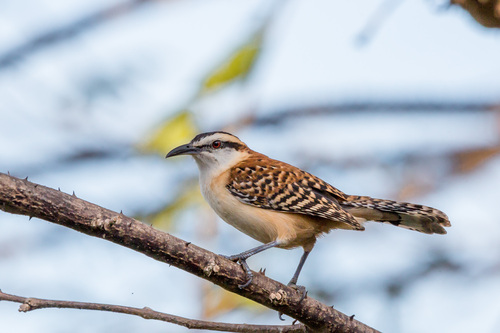
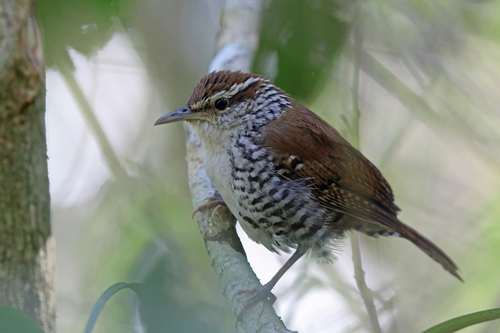
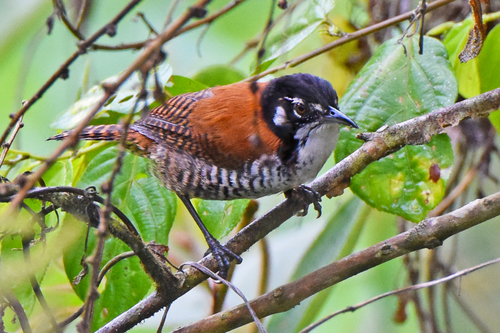
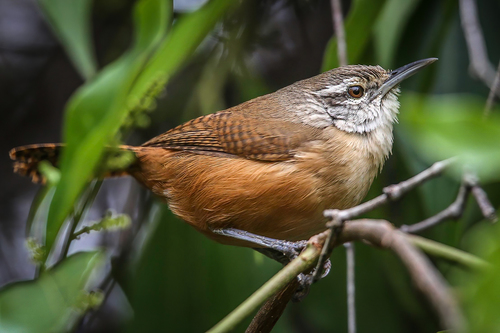
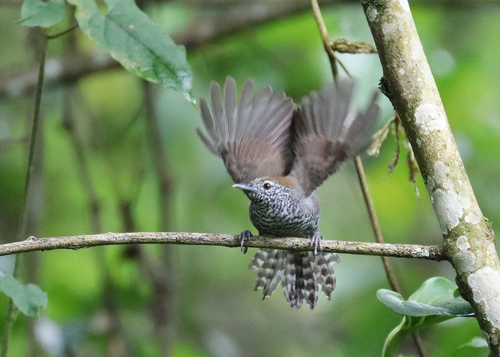
Pheugopedius sclateri (Taczanowski, 1879), commonly known as the speckle-breasted wren, has three recognized subspecies, each with distinct physical traits and ranges. The nominate subspecies P. s. sclateri measures 14.5 to 15.5 cm (5.7 to 6.1 in) long and weighs 20 g (0.71 oz). Adult nominate individuals have a reddish brown crown, medium brown back and rump, and a tail marked with alternating gray and dull black bars. They have a narrow white supercilium, a dark eyestripe, and black-and-white mottling on the sides of the face and neck. Fine black and white bars cover their underparts from the chin through the lower belly; bars on the lower belly and flanks are more diffuse, and the flanks also have a buff wash. Juvenile nominate wrens resemble adults, but their underside bars do not extend as far down the belly.
Subspecies P. s. columbianus is 13 to 14 cm (5.1 to 5.5 in) long. Adults have uniform brown upperparts with a rufous tinge to the crown, a tail with broad dark bars, and a narrow white supercilium. Their face and most of their underparts are white with black bars and spots, and their flanks are dark buff.
Subspecies P. s. paucimaculatus is 13.5 to 15.5 cm (5.3 to 6.1 in) long; males average 12.7 g (0.45 oz) and females average 10 g (0.35 oz). Adults have uniform brown upperparts with black bars on the tail, a narrow white supercilium, and black-and-white speckled cheeks. Most of the underparts are whitish, with a heavily black-speckled breast, and the flanks are rufescent. Juveniles resemble adults but have less heavy speckling on the breast.
The three subspecies occupy separate geographic ranges and somewhat different habitats. P. s. sclateri is found in the Marañon River drainage in extreme southern Ecuador and northern Peru, where it inhabits the undergrowth of dry forest up to approximately 1,600 m (5,200 ft) elevation. P. s. columbianus is found in Colombia, on the separate western slopes of the Central and Eastern Andes; it lives in the thick understory of forest borders and open woodland at elevations between 1,300 and 2,000 m (4,300 and 6,600 ft). P. s. paucimaculatus ranges from Ecuador's Manabí Province south into Peru's Department of Piura. It inhabits the interior and edges of deciduous semi-humid woodland, especially areas with dense understory, and occurs from the lowlands up to approximately 1,600 m (5,200 ft) in Ecuador and up to 2,000 m (6,600 ft) in Peru.