About Pheugopedius rutilus (Vieillot, 1819)
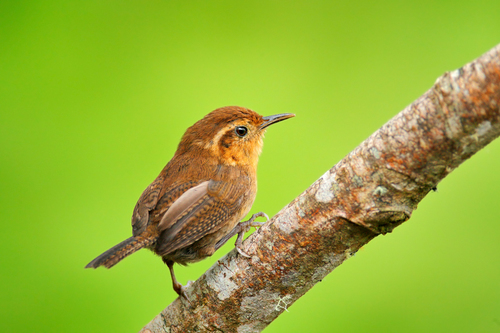
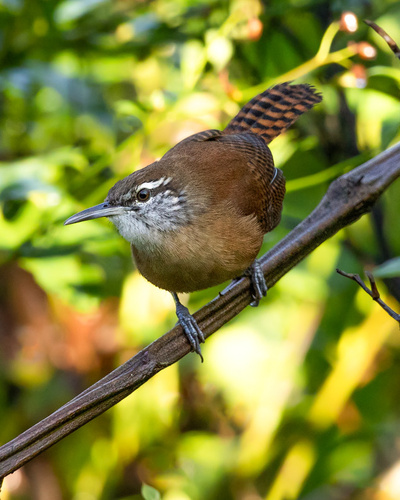
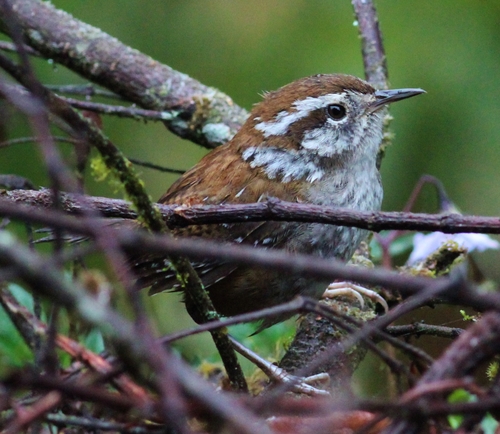
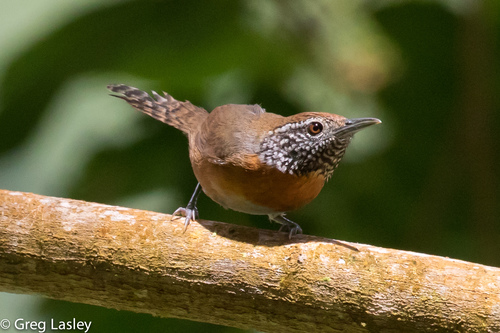
This species, the rufous-breasted wren (scientific name Pheugopedius rutilus (Vieillot, 1819)), has the following physical characteristics and subspecies variation. For adult nominate subspecies rufous-breasted wrens, individuals measure 14 cm (5.5 in) long and weigh between 13.5 and 18.5 g (0.48 to 0.65 oz). Their crowns and upperparts are warm brown; their tail is gray-brown marked with heavy dark brown bars. They have a white supercilium, with a black edge along the upper side of the stripe. Their face and throat are speckled with black and white. Their chest is bright chestnut, while the rest of their underparts are a duller chestnut, with a grayish white center to the belly. Juveniles are duller in overall color than adults, and their facial markings are less distinct. The combination of this facial pattern and a rufous breast is unique to this species within its genus. Multiple recognized subspecies differ slightly from the nominate form: P. r. hyperythrus is similar to the nominate but has additional blackish spots on the chest. P. r. laetus also has blackish chest spots, but its underparts are more richly colored than those of P. r. hyperythrus. Compared to the nominate, P. r. hypospodius is more reddish on the crown and back, has a more tawny chest, and has duller flanks. The underparts of P. r. interior are pale ochre, and its flanks are pale olive brown. P. r. intensus is more richly colored than the nominate, and often shows some spotting on the chest. P. r. tobagensis has a heavier bill than the nominate, along with longer wings and a duller chest. The different subspecies of rufous-breasted wren each have separate distribution ranges: P. r. hyperythrus is found on the Pacific slope of Costa Rica and western Panama. P. r. tobagensis is found on Tobago. P. r. rutilus (the nominate subspecies) is found in the Coastal Range of northern Venezuela, on both slopes of the Andes of northwestern Venezuela, and on Trinidad. P. r. intensus is found in Táchira state, southwestern Venezuela. P. r. laetus is found in far northern Colombia and adjacent northern Venezuela. P. r. interior is found on the western slope of Colombia's Eastern Andes. P. r. hypospodius is found on the eastern slope of Colombia's Eastern Andes. The species as a whole inhabits rainforest and cloudforest, and prefers thickets, second growth, and forest edges over closed forest interior. Its elevational range extends from sea level up to 1,900 m (6,200 ft).