About Pheugopedius maculipectus (Lafresnaye, 1845)
The spot-breasted wren (scientific name Pheugopedius maculipectus (Lafresnaye, 1845)) measures 12.5 to 14 cm (4.9 to 5.5 in) in length. Males weigh 14.3 to 16.8 g (0.50 to 0.59 oz), and females weigh 12.4 to 16.2 g (0.44 to 0.57 oz).
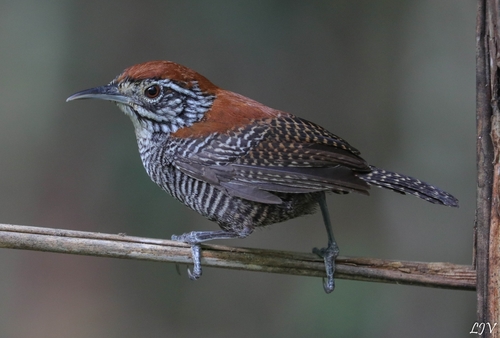
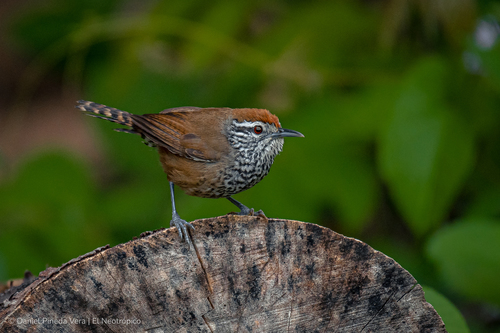
Adults of the nominate subspecies have a reddish brown crown and upperparts, with a more chestnut-colored rump. Their tail is dull brown with narrow dark bars. They have a white supercilium, while the rest of their face and neck are streaked with black and white. The throat, chest, and center of the belly are pale gray with black spots, and the flanks and lower belly are orange-buff and spotless. Juveniles are paler than adults, with less extensive and duller facial markings and spots. The subspecies differ in appearance: P. m. microstictus is less reddish than the nominate and has smaller, fewer spots on its breast; P. m. canobrunneus is paler than the nominate and has a light buffy cinnamon crown; P. m. umbrinus, which includes petersi and varians, is larger and darker than the nominate.
The distribution of the spot-breasted wren's subspecies, including two that are not universally accepted, is as follows: P. m. microstictus is found in northeastern Mexico, from southeastern Nuevo León and central Tamaulipas south to eastern San Luis Potosí and northern Veracruz; P. m. maculopectus is found in eastern Mexico, from Veracruz south to Puebla and northern Oaxaca; P. m. canobrunneus is found on the Yucatán Peninsula, in northern Belize, and in Guatemala's Petén Department; P. m. umbrinus is found from southern Mexico south through southern Belize, most of Guatemala, El Salvador, northern and central Honduras, and the Caribbean slopes of Nicaragua and extreme northern Costa Rica; P. m. petersi ranges from northern Honduras south through Nicaragua to northern Costa Rica; P. m. varians is found on the Pacific slope of Chiapas, Mexico, as well as in Guatemala and El Salvador.
The spot-breasted wren lives in a wide variety of habitats, including intact, disturbed, and regrowing humid coastal and dry forest, as well as cocoa and citrus plantations. In terms of elevation, it ranges from sea level to 1,300 m (4,300 ft) in Mexico and Honduras, but only reaches up to 200 m (660 ft) in Costa Rica.