About Pheugopedius genibarbis (Swainson, 1838)
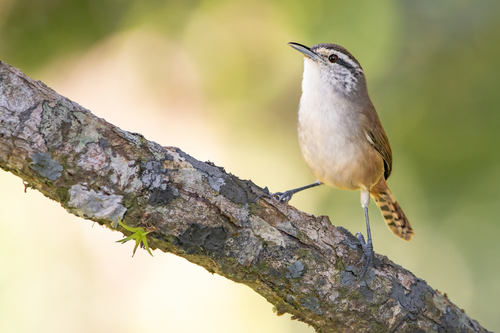
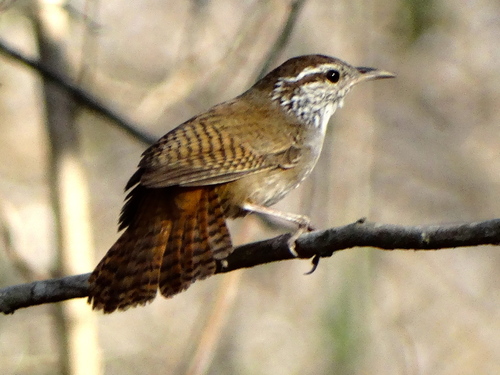
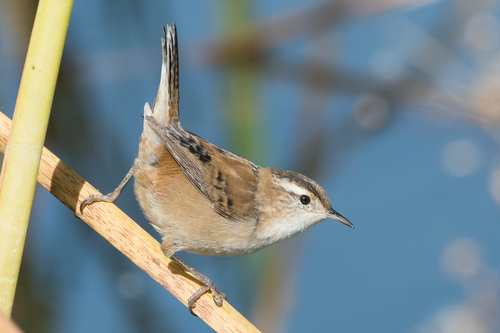
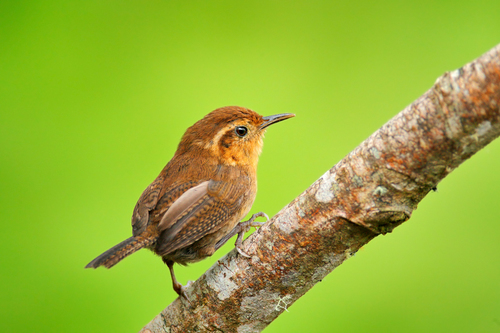
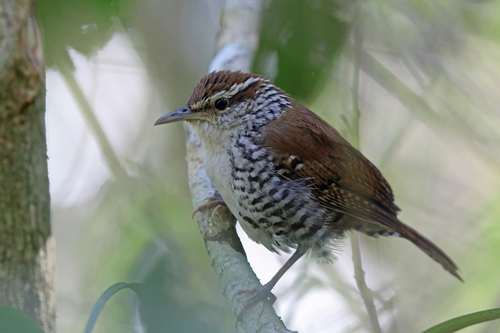
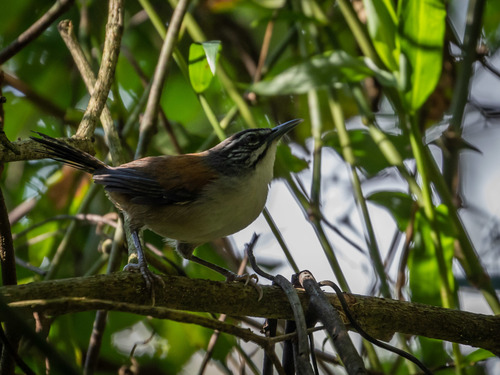
The moustached wren (scientific name Pheugopedius genibarbis (Swainson, 1838)) is 15.5 cm (6.1 in) long and weighs 16.2 to 22.8 g (0.57 to 0.80 oz). Adult nominate P. g. genibarbis have an olivaceous gray-brown crown and nape, bright chestnut back and rump, and a dull brown tail with narrow blackish bars. They have a white supercilium and eyering, a black stripe through the eye, gray-black cheeks streaked with white, a white moustachial stripe, and a black malar stripe. Their throat and upper chest are white, their lower chest is buffy, and their flanks and belly are a deeper brown. Compared to adults, juvenile moustached wrens have a browner crown, a duller back that is less deeply chestnut, less well-defined facial markings, and more diffuse bars on the tail. Four subspecies have documented differences from the nominate. P. g. juruanus is larger than the nominate and has paler underparts. P. g. intercedens has a less sooty crown and duller underparts than the nominate. P. g. bolivianus is similar to intercedens, but compared to the nominate's buff underparts, its underparts are a deeper ochre, and it has more gray on the face.
The moustached wren is found throughout the central and southern Amazon Basin. The subspecies have separate distribution ranges: P. g. juruanus occurs in eastern Brazil, from the Madeira River east to the Atlantic coast; P. g. genibarbis occurs in the upper Amazon River drainage of eastern Peru, western Brazil as far east as the Madeira River, and probably in northern and western Bolivia; P. g. intercedens occurs in the Brazilian states of Mato Grosso and Goiás in central Brazil; P. g. bolivianus occurs in the northern Santa Cruz Department of eastern Bolivia. The species inhabits forest edge, including areas along rivers, and favors dense stands of Bambusa bamboo. In terms of elevation, it can reach as high as 1,500 m (4,900 ft) in Bolivia, but generally occurs from sea level up to middle elevations.