About Pheucticus tibialis Lawrence, 1867
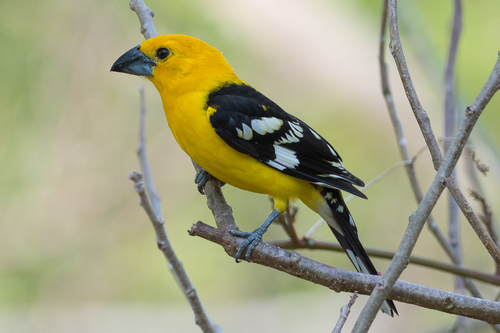
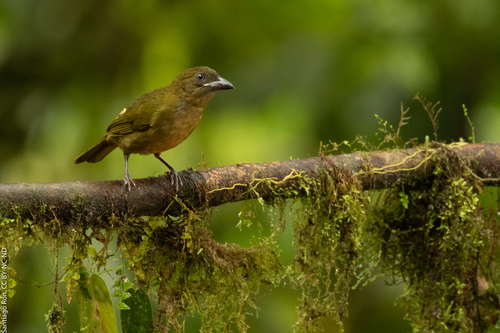
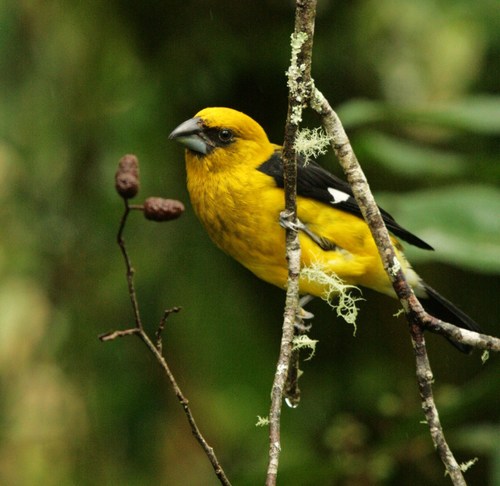
The black-thighed grosbeak, scientifically named Pheucticus tibialis, is a large seed-eating bird in the Cardinalidae family. It is endemic to the mountains of Costa Rica and western Panama. This species breeds at altitudes ranging from about 1,000 meters (3,300 feet) on the Pacific slope, or 1,500 meters (4,900 feet) on the Caribbean slope, up to 2,600 meters (8,500 feet). It inhabits tree canopies, woodland edges, and semi-open habitats like pastures that contain scattered trees. Its nest is a thin cup built on a bulky base of twigs, placed 1 to 3 meters (3.3 to 9.8 feet) up in a small tree or among vines. Between March and May, females lay two pale blue eggs marked with brown spots. Adult black-thighed grosbeaks measure 20 centimeters (7.9 inches) long and weigh 70 grams (2.5 ounces), and they have a large grey bill. Males have yellow heads, rumps, and underparts, a black back edged with olive, and black wings, thighs, and tails. They have a white patch on their flight feathers. Females are paler than males, have more olive coloring on the back, and have a smaller white patch on the wing. Immature birds are duller, with more olive-tinged plumage, and have streaked and mottled body feathers. Black-thighed grosbeaks forage in shrubs or trees, feeding on insects, seeds, and berries. Their call is a sharp pink, and their song is a musical sequence of warbles, whistles, trills, and slurs.