About Pheucticus melanocephalus (Swainson, 1827)
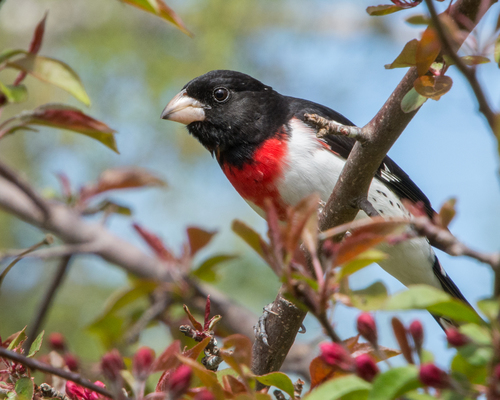
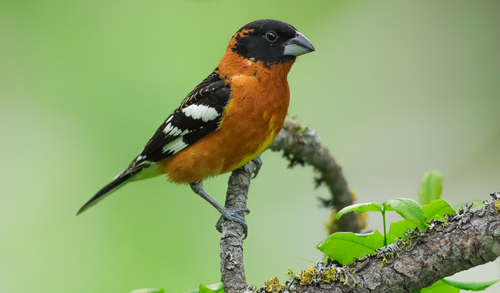
Pheucticus melanocephalus, commonly called the black-headed grosbeak, falls within the following measurements: length 7.1–7.5 in (18–19 cm), weight 1.2–1.7 oz (34–48 g), and wingspan 12.6 inches (32 cm). This species is similar in size to a common starling. As its common name suggests, the male has a black head, and black wings and tail marked with prominent white patches. The male’s breast ranges from dark to tawny orange, and its belly is yellow. The female has a brown head, neck, and back with sparrow-like black streaks; it also has white streaks running down the middle of its head, over its eyes, and across its cheeks. The female’s breast is white, while its wings and tail are grayish-brown with two white wing bars and yellowish wing edges. The black-headed grosbeak prefers to inhabit deciduous and mixed wooded areas, favoring locations with large trees and thick bushes. Preferred habitat includes patches of broadleaved trees and shrubs within conifer forests, as well as streamside corridors, river bottoms, lakeshores, wetlands, and suburban areas. The breeding range of black-headed grosbeaks extends from the Pacific Coast to the middle of the US Great Plains, and from southwestern Canada to the mountains of Mexico. Birds that breed in the US and Canada are highly migratory, and winter in Mexico. In the Great Plains, the range of the black-headed grosbeak overlaps with that of the rose-breasted grosbeak, and the two species have interbred to some extent. After the breeding season ends, black-headed grosbeaks typically move into areas with abundant berries. They migrate south early in the fall and return to northern breeding grounds late in the spring, and they are known to make these migrations in flocks.