About Pheucticus chrysopeplus (Vigors, 1832)
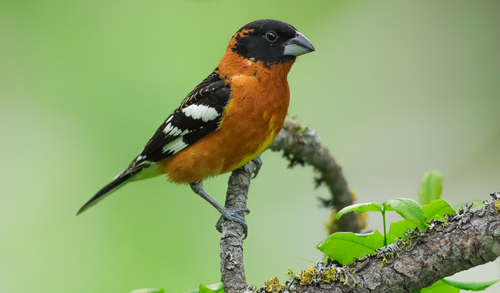
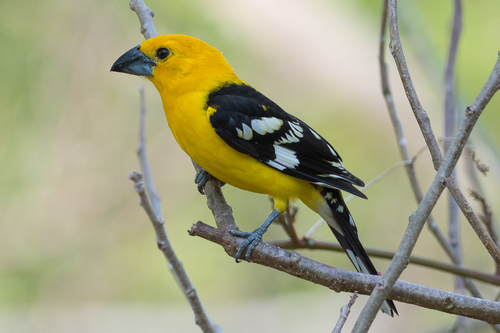
The yellow grosbeak (scientific name Pheucticus chrysopeplus), also called the Mexican yellow grosbeak, is a medium-sized seed-eating bird. It belongs to the same family as the northern cardinal, tropical/New World buntings, and cardinal-grosbeaks/New World grosbeaks. This species is found on the Pacific slope of Mexico, ranging from central Sonora to northwestern Oaxaca, and also occurs in southern Chiapas and Guatemala. It is migratory in Sonora. It has previously been considered conspecific with P. tibialis from Central America and P. chrysogaster from South America. Yellow grosbeaks mostly live in trees in forests, woodlands, and forest edges, and are generally not found in dense rain forests or cloud forests. Occasional vagrant individuals have reached the United States, mostly in Arizona during summer, but have also been reported in California, Colorado, New Mexico, and even Iowa. It is noticeably larger than its North American close relatives, the black-headed grosbeak and the rose-breasted grosbeak. It measures approximately 21.5–24 cm (8.5–9.4 in) long, and has an average weight of 62 g (2.2 oz). Its head is described as massive, and its gray-black bill is even larger relative to the head than the bills of its northern relatives. The species' plumage has bold contrasts of yellow, white, and black or gray. Males have solid yellow heads and underparts: light lemon yellow in most populations, and brilliant golden-orange in the subspecies P. c. aurantiacus found in Chiapas and Guatemala, per Howell and Webb 1995. Males have a black back with yellow mottlings, a yellow rump, and black upper tail coverts with white tips. Their wings and tail are black, marked with prominent white spots, patches, and wingbars. Females have a similar overall pattern, but their upperparts are more olive-toned, with dark streaks on the crown and back. Black plumage is replaced by gray in females, and their white wing markings—especially the white base of the primaries—are smaller. Female yellow grosbeaks have a very similar pattern to female flame-colored tanagers, but are much larger, particularly in the size of the bill. Immature yellow grosbeaks generally resemble adult females. The species' typical calls include a metallic iehk, plihk per Howell and Webb, or piik, which matches the calls of other Pheucticus grosbeaks. It also produces a soft whoi, hu-oi per Howell and Webb 1995, or hoee per Sibley 2000, often given during flight. Its song is a variable, rich-toned warble that resembles the song of the black-headed grosbeak, but is shorter. As is typical for the genus Pheucticus, the yellow grosbeak lays two to five pale bluish to greenish eggs that have heavy brown and gray speckling. It builds a cup-shaped nest at medium height in a bush or small tree.