About Pheucticus aureoventris (d'Orbigny & Lafresnaye, 1837)
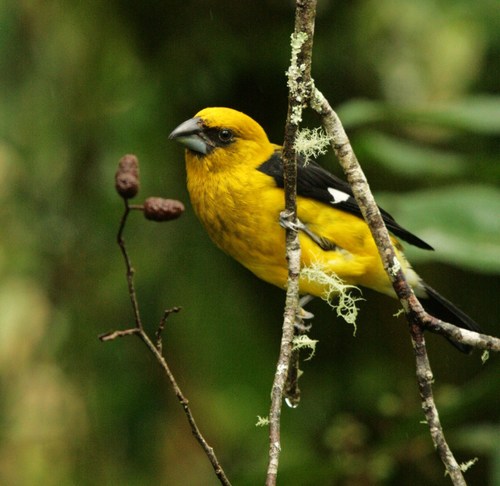
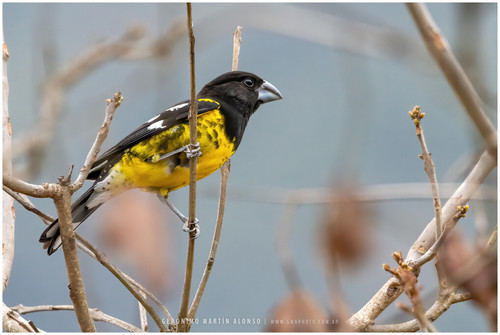
The black-backed grosbeak (scientific name Pheucticus aureoventris) measures approximately 22 cm (8.7 in) long, and weighs between 43.8 and 66.2 grams (1.54 to 2.34 oz). All of its subspecies are very similar except for P. a. crissalis. Males have black upperparts with a yellow shoulder patch, and white patches appear on their closed wings. Their chin, throat, and upper breast are also black, while the lower breast and belly are bright yellow, with a variable amount of black flecking on the sides and flanks. Females are similar to males but have browner coloring, yellow mottling on the upperside, and dusky speckles on the underside. P. a. crissalis differs from other subspecies mainly by having a yellow chin, throat, and upper breast where other subspecies have black. The black-backed grosbeak is native to the eastern Andes, where its subspecies occupy distinct ranges. All subspecies except the nominate are believed to be non-migratory. P. a. meridensis is found in Mérida state, northwestern Venezuela. P. a. uropygialis lives in the Eastern Andes of Colombia. P. a. crissalis ranges from Colombia's Nariño Department south to central Ecuador. P. a. terminalis occurs in Peru's Amazonas and Cuzco departments. The nominate subspecies P. a. aureoventris breeds in Peru's Puno Province, western and southern Bolivia, and northwestern Argentina; during the austral winter, it expands its range into west-central Brazil and northern Paraguay. The black-backed grosbeak inhabits dry to very dry, scrubby to open woodland, and is often found in gardens. Its elevation range varies across its distribution: in Venezuela, it generally occurs between 1,450 and 2,000 m (4,760 to 6,560 ft), and occasionally reaches up to 3,700 m (12,100 ft); in Colombia it is found between 1,700 and 3,000 m (5,600 and 9,800 ft); in Peru it mostly occurs from 1,200 to 3,200 m (3,900 to 10,500 ft); at the southern end of its range it can be found as low as 600 m (2,000 ft).