About Pheosia tremula (Clerck, 1759)
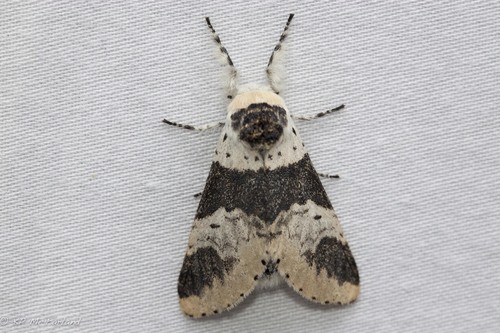
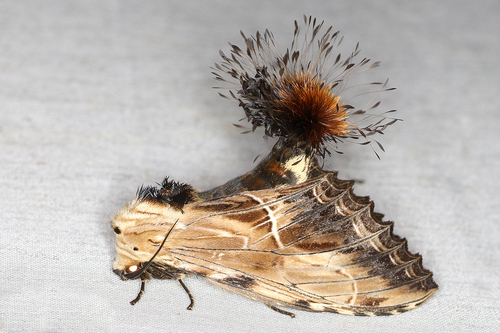
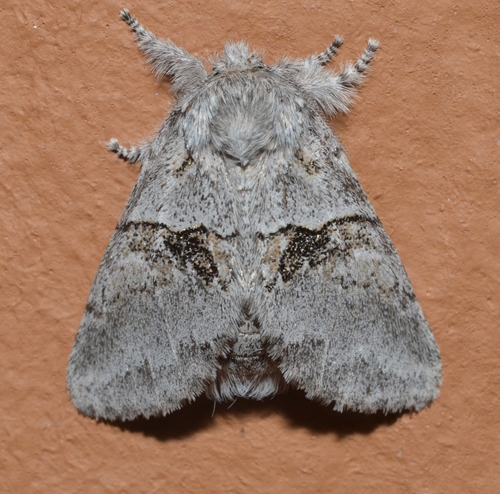
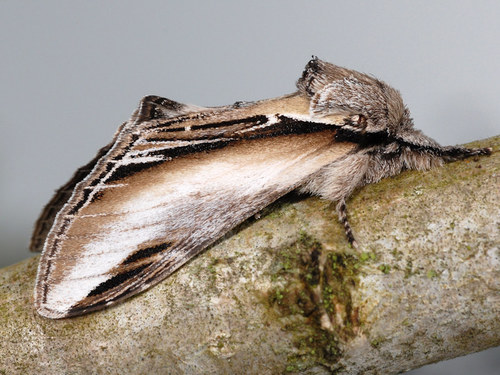
Pheosia tremula (Clerck, 1759) is generally colored whitish, with a brown-shaded black stripe along the inner margin of the forewings, and a brownish cloud containing black streaks towards the tips of these wings. The outer ends of the forewing veins are white; there is a white wedge-shaped streak between veins 1 and 2, and an indented white line runs from the apex of this streak to the base of the wing. In some individuals, the entire discal area of the forewings is suffused with brownish color. The adult imago can easily be mistaken for Pheosia gnoma.
According to Seitz's description: the head and thorax are grey or predominantly brown, and the abdomen is greyish brown. The forewing is whitish, and brownish at the margins. Beyond the middle of the costal margin there are 2 black longitudinal smears, which often merge together to form a band. A black longitudinal line runs in front of the hind margin from the base to the distal margin. Below vein 1 there is a long white wedge-spot that extends to the distal margin, with its distal end filled in with dark color. The apical portions of veins 2 through 4 are white. The hindwing is whitish, and blackish along the anal angle, with a narrow white marginal line within this black area.
This species is distributed throughout Central Europe, northward to the Baltic provinces of Russia, southward to Northern Spain, Central Italy, Southern Russia, and Armenia; it is also found in Amurland. The egg is moderately convex, minutely punctate, and light green or yellowish green. The larva occurs in two color varieties: one is glossy light green with a whitish dorsum, a red-brown transverse bar on the tubercle, an orange-yellow longitudinal line below the spiracles, and red stigma-spots; the other is uniformly brown-red. In both varieties, the stigmata are black with a white border. Larvae can be found from June to October feeding on Populus and Salix species, and also on birch. The pupa is dark brown, and develops underground inside a hard cell lined with silk. Adult moths are common across their range, and fly in May, and July to August. Only one brood is produced per year in the northern part of the range.