About Phenacovolva rosea (A.Adams, 1855)
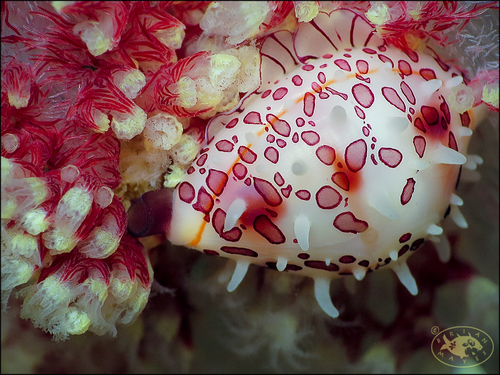
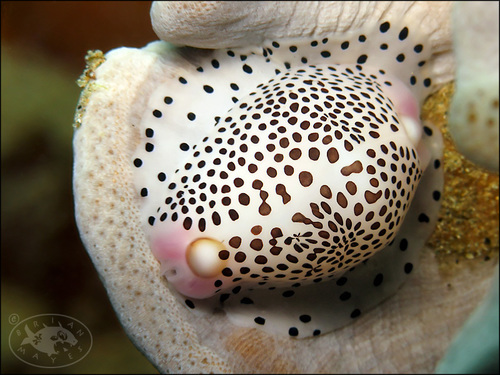
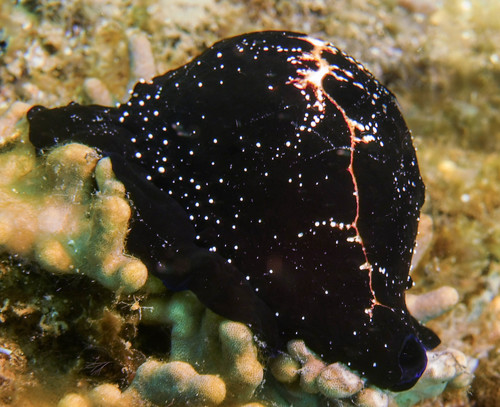
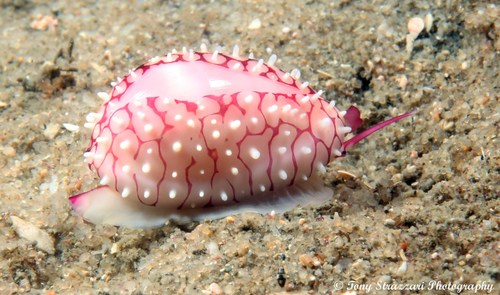
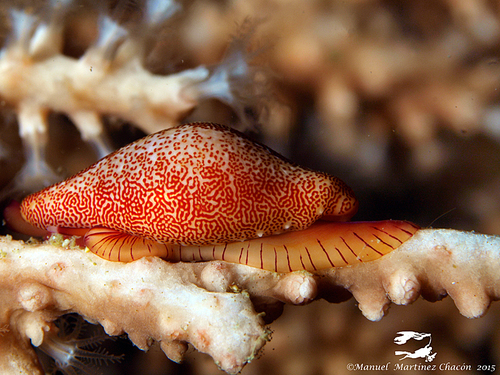
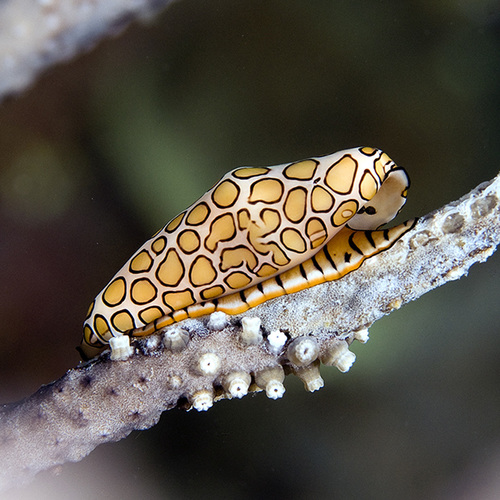
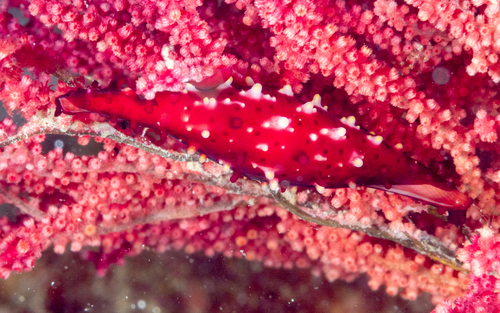
Phenacovolva rosea, commonly called the rosy spindle cowry, is an elongated sea snail species with an aperture running the full length of its shell. Its shell is fusiform, or cigar-shaped, with slender tapering ends and a slightly wider central section. Adult shells range in length from 23 to 57 mm (0.9 to 2.2 in), and the spire is nearly invisible. Crenelations are present on the aperture lip at the dorsal end, and these grow smaller toward the centre of the shell. The shell is typically pale pink, orange, or brown, and most individuals have a paler band across the central section. When alive, the mantle almost completely covers the shell; it is translucent, shimmers in reddish-orange (or occasionally yellow), sometimes has darker specks or white streaks, and is covered in orange, red, or tan plume-like protuberances. This species closely resembles Phenacovolva nectarea in appearance, but P. nectarea can usually be distinguished by an additional faint dark band near the shell centre that P. rosea lacks. The rosy spindle cowry has a wide distribution across the Indo-Pacific region, where it is relatively common. Its range stretches from the east coast of Africa to Indonesia, southern Japan, New Caledonia, and tropical Australia, and it occurs at depths down to approximately 250 m (820 ft). This mollusc is always found living in association with gorgonian corals, and it can inhabit a variety of gorgonian forms including fan, whip, and bush types. It anchors itself to its host with a long, narrow foot. It is a carnivore that feeds on the polyps and soft tissues of its host gorgonian, and can be classed as an ectoparasite. The rosy spindle cowry has separate sexes. Females deposit a cluster of several dozen egg capsules on their host gorgonian, with each capsule holding hundreds of eggs. Its larvae are planktonic, and must settle on a suitable gorgonian host to complete their development.