About Phellodon confluens (Pers.) Pouzar
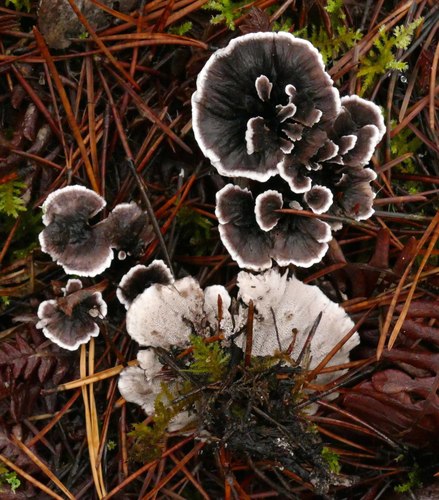
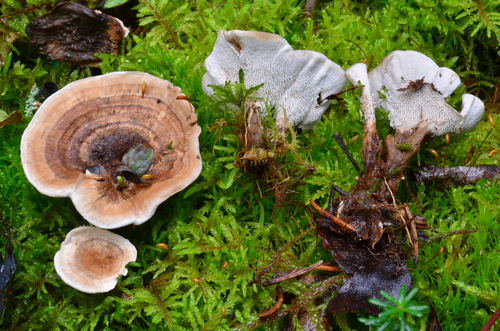
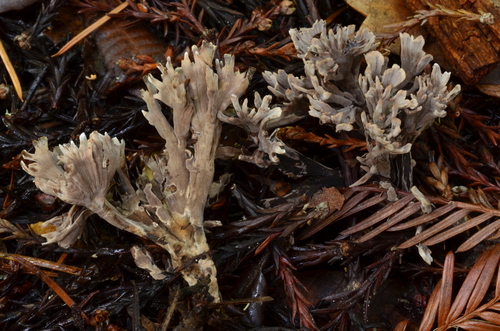
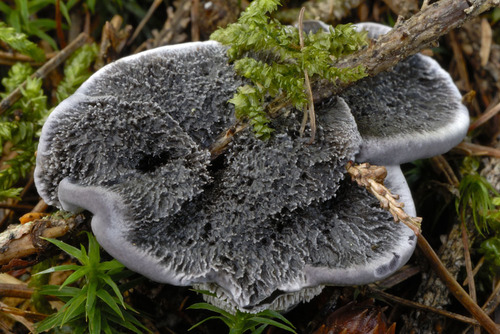
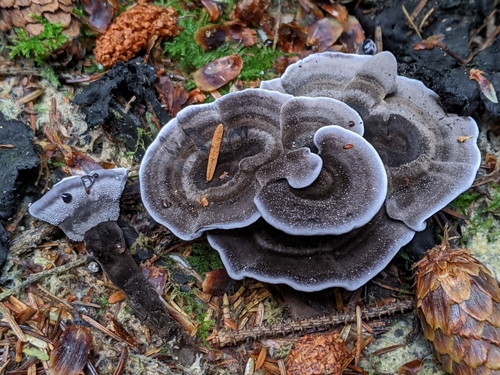
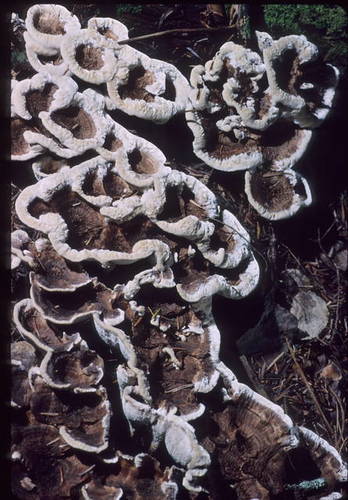
Phellodon confluens (Pers.) Pouzar produces firm, corky-textured fruit bodies, also called basidiocarps. The cap, or pileus, has a round to irregular outline, grows 3–9 cm in diameter, and often fuses with adjacent caps to form clusters. Young caps are whitish grey, smooth (glabrous), and darken to brown or almost black as they age. The cap surface may be slightly depressed or pitted, and new smaller pilei frequently grow from its margin. On the underside of the cap, the hymenophore—the fertile, spore-bearing surface—is densely toothed (hydnoid), rather than gilled or pored. Individual spines on the hymenophore grow up to 3 mm long, and are white to pale grey. The flesh, or context, is organized in two layers (duplex), a feature that is especially noticeable in the stalk. Flesh color ranges from pinkish brown to dark brown, and has a faintly spicy taste when sampled. The stalk, or stipe, measures 10–40 by 10–20 mm, has a fine, woolly (tomentose) grey to dark brown covering, and firmly supports the cap. Microscopically, this fungus has a monomitic hyphal system, which contains only generative hyphae. These hyphae are simple-septate, meaning each cell is divided by a single cross-wall, translucent (hyaline), and 3–6 μm wide. Its spores are roughly elliptic, 3.5–4 by 3–4 μm in size, hyaline, and covered in minute spines. This fungus has a northern hemisphere distribution, and is found in Asia, Europe, and North America. It is classified as vulnerable in Switzerland. In northern Europe, it follows the distribution of its host tree Quercus, and extends as far north as central Sweden and southern Finland.