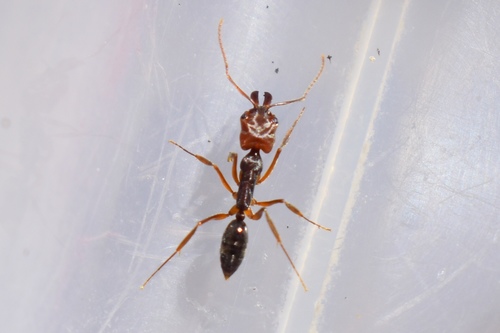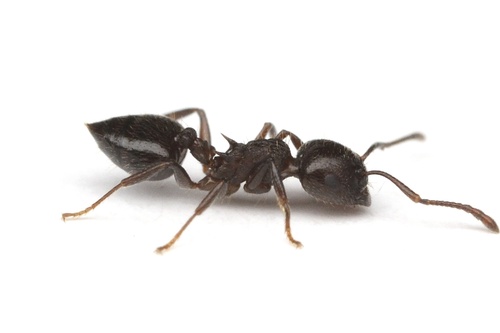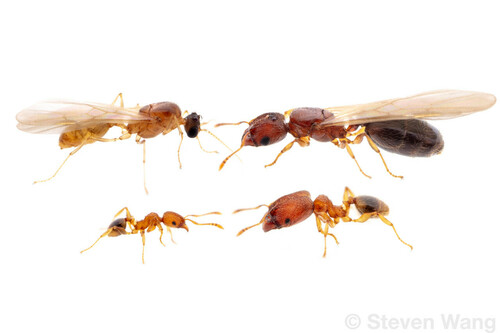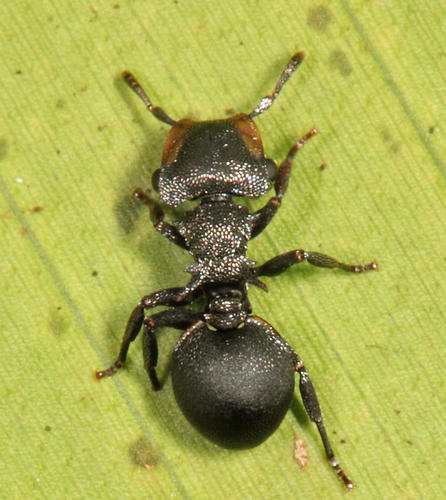
About Pheidole navigans Forel
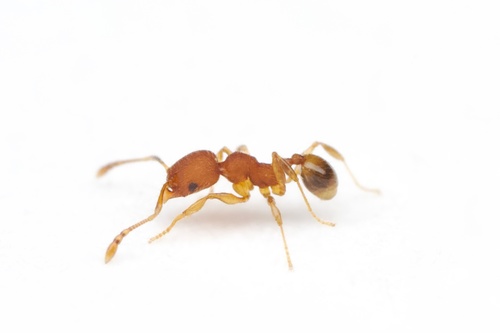
Identification: Pheidole navigans Forel belongs to the subfamily Myrmicinae, which is defined by a two-segmented waist made up of a petiole and postpetiole, a fused promesonotum, frontal lobes covering the antennal sockets, and generally triangular mandibles with rare exceptions. Within this subfamily, the genus Pheidole is distinctly recognized by clearly dimorphic worker castes (rarely continuously polymorphic), a three- or four-segmented antennal club, and 12-segmented antennae. The only exceptions are two groups of small Neotropical Pheidole: the P. tachigaliae species group with 11 antennal segments, and the P. perpusilla species group with 10. Among Neotropical Pheidole, P. navigans is part of the P. flavens species group, which can be identified by a combination of traits: 12-segmented antennae, a three-segmented antennal club, small to medium body size, an absent or vestigial mesosomal convexity, a relatively thick antennal club, a short scape, a moderately curved head shape, relatively shallow antennal scrobes, no ladder-like transverse carinae on the major worker's head, no cephalic phragmotism in major workers, and a very short metanotum in major workers. The major workers of P. navigans can be distinguished from closely related P. flavens and P. moerens by longitudinal rugae on the posterior lobes of the head, a longer, more distinct, narrower antennal scrobe with a stronger and more continuous frontal carina, a more glossy scrobe depression, and transverse striae on the dorsal surface of the promesonotum. However, P. navigans minor workers cannot be distinguished from other species in the P. flavens species complex. Morphology: Pheidole navigans is a small, short-limbed ant species that ranges in color from reddish-brown to dark brown. Total body length measurements are: 2.0 millimetres (0.079 in) for minor workers, 2.4 millimetres (0.094 in) for major workers, 2.8 millimetres (0.11 in) for males, and 3.5 millimetres (0.14 in) for queens. It is morphologically similar to multiple other species in the Pheidole flavens species group, including Pheidole flavens, Pheidole glomericeps, and Pheidole moerens, which led to frequent misidentifications in its invasive range before 2015. In 1985, color variation in the species was suspected to be caused by dietary differences: colonies fed honey and seeds developed lighter coloration than colonies fed house flies. P. navigans queens are small and blackish, and otherwise share most traits with other members of their species group with no distinct morphological features. Distribution: Pheidole navigans is native to the Neotropics, where it has been recorded from Brazil, Colombia, Venezuela and Paraguay. It is an established invasive species in many regions, including California, the southeastern United States, Madeira, Tenerife (Spain), Hawaii, and Vanuatu, and may have spread further beyond these recorded locations. It was often misidentified in its invasive range, most commonly as Pheidole moerens, before 2015. It is classified as a category D2 invasive, meaning it can survive, reproduce, and maintain a stable population in regions where it has been introduced. It exerts strong propagule pressure, and appears frequently in interception records worldwide. The first established populations recorded outside its native range were found in Alabama in 1967 and Florida in 1975. It has since slowly expanded its range across the southeastern United States, reaching Georgia, Mississippi, North Carolina, and Texas by 2018. It spread to southern California by 1995, Hawaii by 2003, and Vanuatu in 2011. It was first recorded in Madeira in 2014, where it may successfully displace other widespread invasive ant species in the region, such as Pheidole megacephala and Linepithema humile, near the city of Funchal. In Bermuda, the first established population was recorded in 2016, though interception reports of the species date back to 2004. The first established population in the Canary Islands was recorded by 2020 in a farming area in northern Tenerife, and the first record for continental Europe comes from a series of minor workers collected in Málaga, Spain in 2021. Ecology: In Florida, P. navigans is fairly common and nests in a wide range of microhabitats, including under boards, at the bases of fence posts and oak trees, in rotten wood, wall crevices, hollow twigs, nuts, and leaf litter, and occasionally nests arboreally. It is a generalist forager that consumes a wide variety of foods, ranging from small arthropods and seeds to sugars and human food. It is not reported to be a major house pest. Mature colonies contain more than 100 major workers and 500 total workers, and nuptial flights mostly take place in July. The species is monogynous, but undergoes pleometrosis: multiple queens may cooperate to found a new colony, but only one queen survives after the colony founding stage. It also practices dependent colony foundation, also called budding, where existing colonies split to form autonomous daughter groups that separate to establish new colonies. Its nest chambers have small openings and are constructed from soil and debris. Major workers often forage alongside minor workers, and all foraging occurs very close to the nest. The species is attracted to both sugar and protein baits, and responds extremely quickly to tuna baits by recruiting both major and minor workers. Although P. navigans is widespread in Florida and other parts of the southeastern United States, its ecological impacts are not well studied. In Florida, it appears to be partially successful at displacing native congeneric species Pheidole dentigula and Pheidole bilimeki. It may compete for nesting space with native ant species in the southeastern United States, including species from the genera Aphaenogaster, Camponotus, Nylanderia, Solenopsis, Hypoponera, Strumigenys, Brachymyrmex, and others.