About Phedina borbonica (Gmelin, 1789)
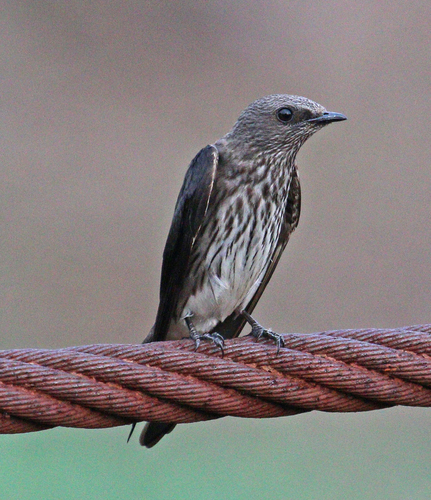
Scientific name: Phedina borbonica (Gmelin, 1789). For the adult Mascarene martin of the nominate subspecies, body length is 15 cm (5.9 in), average wing length is 117 mm (4.6 in), and average weight is 23.9 g (0.84 oz). This small member of the hirundine family has dark brown-grey faintly streaked upperparts. Its underparts are grey-brown, fading to white on the throat and lower abdomen, and all underparts are heavily marked with black streaks. The slightly forked tail averages 54.6 mm (2.15 in) long, and the brown undertail coverts have white edges. The wings are blackish-brown, and the bill and legs are black. Eyes are dark brown, and the black bill averages 11.3 mm (0.44 in) long. The two sexes look identical. Juveniles have more diffuse breast streaking, and the feathers covering their closed wing have white tips. The Madagascan subspecies is paler overall and has a larger bill than the nominate form. It has denser streaking on the breast, but only very fine lines on the lower abdomen and the white undertail. It is distinctly smaller than the nominate subspecies, with a body length of 12–14 cm (4.7–5.5 in) and an average weight of 20.6 g (0.73 oz). On Mauritius, this species moults in December and January. Madagascan breeding birds that winter on the African mainland moult in June and July. The Mascarene martin is a relatively quiet bird. It produces a warbled siri-liri siri-liri song when flying or perching; some calls from perched birds end in a glissando. Other vocalizations may be used during mating or aggressive displays. It has a chip contact call, and young birds produce a fast twittering sound when begging for food. Birds wintering in mainland Africa are usually silent. No other streaked swallow species lives within the island breeding range of the Mascarene martin. In Africa, the lesser striped swallow is larger, has a deeply forked tail, very different plumage with dark blue upperparts, a red rump and a chestnut head. The brown-throated sand martin has similar structure and plumage color to the Mascarene martin, but has plain, unstreaked underparts. The small Mascarene swiftlet has longer, narrower wings than the martin, and a much lighter flight pattern. Brazza's martin is smaller, has a plainer back and finer streaking on the throat and chest, but there is no overlap in their ranges. The breeding range of the Mascarene martin is restricted to Madagascar and the Mascarene Islands. The nominate subspecies breeds on Mauritius and Réunion, while P. b. madagascariensis occurs in Madagascar. The species may also nest on Pemba Island, where it has been sighted during the breeding season. Breeding habitat includes any location with suitable sites for nest construction, such as ledges, buildings, tunnels, caves, or among rocks. On Réunion, the species occurs on the east side between 200–500 m (660–1,640 ft), and on Mauritius it occurs on the south and west coasts, as well as on inland cliffs. The nominate subspecies P. b. borbonica is resident on Mauritius and Réunion, though it makes local seasonal movements within these islands. The Madagascan subspecies is migratory. It deserts the Imerina Plateau from April to September, moving to lower ground or the African mainland. It is normally uncommon and restricted to small local areas in coastal Mozambique, Zambia, Malawi and Pemba Island, and very rare in Kenya and mainland Tanzania, though large numbers sometimes winter in Mozambique or Malawi. It has also been recorded from the Comoros and other Indian Ocean locations, including at least four islands in the Seychelles. As of 2012, a total of eight individual birds had been sighted in the Seychelles, during both the spring and autumn migration periods. Some of these records may be of vagrant birds carried by cyclones. There are unsubstantiated claims that the species occurs in the Transvaal.