About Phedimus kamtschaticus (Fisch.) 't Hart
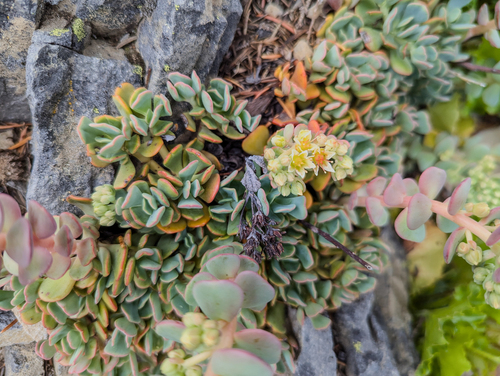
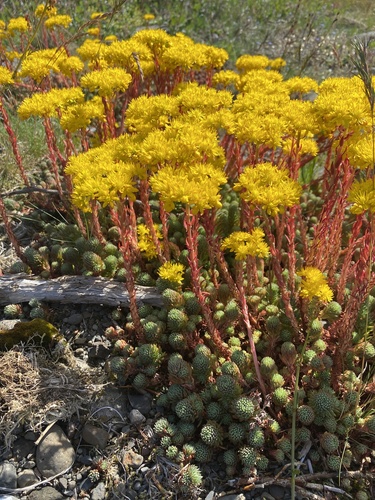
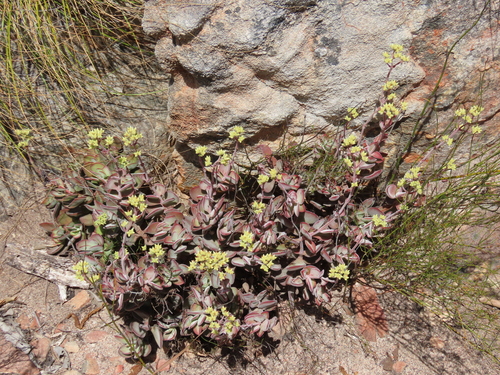
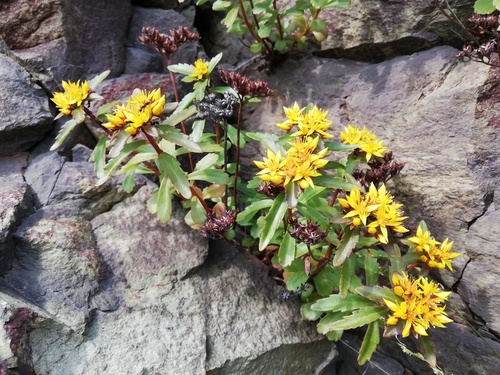
Phedimus kamtschaticus (Fisch.) 't Hart is a succulent, clump-forming herbaceous perennial plant. It has a thick, woody, branched rootstock. Stems grow mostly upright, reaching 15 to 40 cm tall, and may sometimes bear tiny, wart-like bumps. Leaves are arranged alternately along the stem, in opposite pairs, or rarely in groups of three. Leaves are either narrow and spoon-shaped or broad and oval, measuring 2.5–7 cm long and 0.5–3 cm wide. Each leaf has a narrow, tapering base, its edges near the tip may bear small, rounded or sharp teeth, and its tip is blunt or rounded. Its foliage is semi-evergreen, and most disappears over winter. Star-shaped flowers grow at the tips of stems and bloom in early summer. Each flower has five parts of uneven size. The small green sepals, which are leaf-like structures that protect the flower bud, are 3–4 mm long and narrow, with a broad base and blunt tip. The yellow petals are 6–8 mm long, narrow and pointed, with a distinct ridge running along their underside. Petal tips taper to a fine point, sometimes ending in a tiny extension. The flower holds 10 pollen-producing stamens, which are slightly shorter than the petals and have orange anthers at their tips. Tiny, four-sided nectar glands sit at the base of the flower. The carpels, structures that develop into seed pods, stand upright, are about the same length as the petals or slightly shorter, have a slight bulge on their inner side, and are fused together at the base for roughly 2 mm. In late summer, flowers are replaced by dry seed pods called follicles, which spread out in a horizontal star-like pattern. The fruits turn russet red in autumn. The seeds themselves are tiny, brown, and oval-shaped. The specific epithet kamtschaticus refers to the species' origin on the Kamchatka Peninsula. Phedimus kamtschaticus grows on rocky slopes at elevations between 600 and 1,800 meters. Its native range covers multiple northern Chinese provinces: Hebei, Heilongjiang, Jilin, Liaoning, and Inner Mongolia. Outside of China, it is native to Japan, Korea, and Russia. In Russia, it occurs across a wide area including Amur, Kamchatka, Khabarovsk, the Kuril Islands, Magadan, Primorsky Krai, Sakhalin, and Yakutia. This species has been introduced to New York (U.S.), Norway, Germany, Austria, and the Baltic states. It can sometimes persist as a cultivation remnant or escape from discarded garden plants, growing along roadsides, railway embankments, and disturbed ground. It occasionally spreads via self-seeding. The first documented record of this species growing wild in the United Kingdom dates to 1981 at Slepe Heath, Dorset. While its distribution there remains patchy, records indicate it is becoming more widespread. Phedimus kamtschaticus is easy to grow in well-draining soil with moderate to low moisture and full sunlight. It adapts well to sandy or rocky ground, and tolerates heat and low-nutrient conditions. Good drainage is required for healthy growth, but this species tolerates much more soil moisture than other stonecrops, and is also less drought tolerant. It is commonly planted in containers and rock gardens, and can also be grown as a groundcover for small areas and in green roof plantings. Under its former synonym Sedum kamtschaticum, it has received the Royal Horticultural Society's Award of Garden Merit. The putative variety Sedum kamtschaticum var. ellacombeanum and the 'Variegatum' cultivar have also earned this award. The cultivar 'Weihenstephaner Gold', named after the Hochschule Weihenstephan-Triesdorf, is particularly popular with commercial growers. All cultivars produce yellow blooms, but the flowers of 'Weihenstephaner Gold' develop pink tones as they age. Phedimus kamtschaticus is edible; its young leaves and stems may be cooked. In Chinese herbal medicine, freshly crushed P. kamtschaticus is applied to wounds, burns, snakebites, and other injuries to relieve pain, reduce swelling, and improve blood circulation.