About Phedimus aizoon (L.) 't Hart
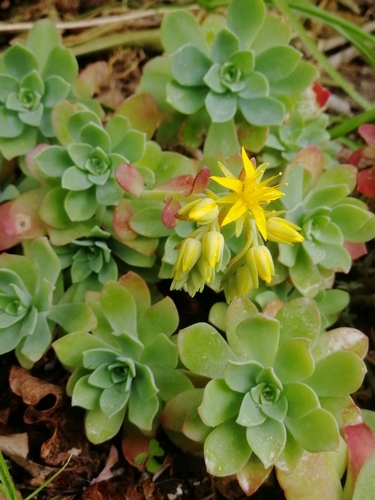
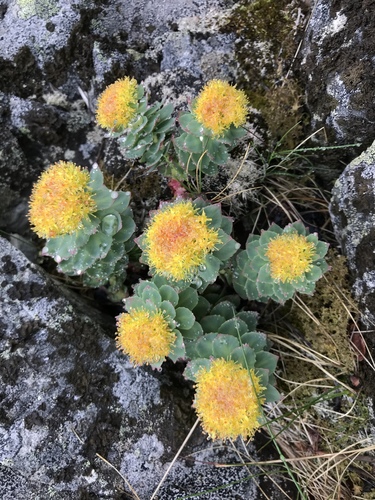
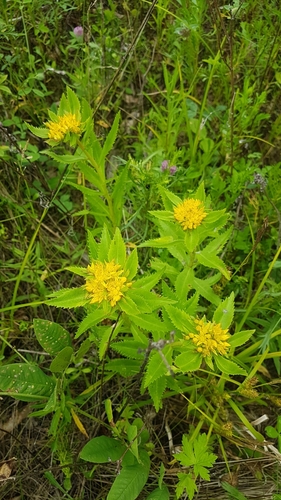
Phedimus aizoon is a non-creeping stonecrop that regrows annually from a sturdy, woody rootstock, with tuberous roots ranging from carrot-shaped to narrowly conical. It produces 1 to 3 upright, unbranched stems, typically growing 20 to 50 cm tall. Its leaves are arranged alternately along the stem, varying in shape from narrow lance-like forms to broader shapes including elliptic, ovate, or nearly round. Leaves measure 3.5–8 cm long and 0.5–3 cm wide, with a wedge-shaped base, an irregularly serrated edge, and a tip that may be rounded or pointed, and are deciduous. Flowers grow in horizontally branched clusters that hold numerous blooms and leaf-like bracts. Each flower has five segments of uneven size. Sepals are slender, 3–5 mm long, with an obtuse tip. Yellow petals are oblong to lance-shaped, 6–10 mm long, and taper to a fine point. The flower holds ten stamens, which are shorter than the petals. Small four-sided nectar glands, around 0.3 mm in size, are present at the base of the flower. Carpels, which later develop into seed pods, are oblong with a convex outer surface and fused together at the base. Styles are slender and tapering. As the plant matures, it produces star-like seed pods around 7 mm long. Seeds are tiny, ellipsoid, and approximately 1 mm in size. This species typically flowers in early summer and fruits in late summer. Its specific epithet, derived from Greek, means "everliving", which likely refers to the ability of most stonecrops to persist as hardy, long-lasting plants. Botanist Harald Fröderström considered Phedimus kamtschaticus and P. aizoon to be a single highly variable species, but today the two are recognized as distinct species within a large species complex. Two varieties of Phedimus aizoon are widely recognized: P. aizoon var. aizoon and P. aizoon var. scaber. Phedimus aizoon is typically found in rugged environments, including ravine edges in valleys, rocky slope grasslands, and dry sunny mountain areas. It also grows in sandy or grassy slope habitats, field edges, and rocky crevices. The species grows at elevations ranging from 1,000 to 3,100 meters. It is native to Central and East Asia, occurring across much of Russia including Altay, Amur, Buryatia, Chita, Irkutsk, Khabarovsk, Krasnoyarsk, Primorye, Sakhalin, Tuva, West Siberia, and Yakutia. It is also found in Mongolia, Kazakhstan, Korea, Japan, the Kuril Islands, and multiple regions of China: North China, Central China, East China, South China, South-Central China, Southeast China, and South-West China. The species has been introduced to Europe (Austria, Germany, Czechoslovakia, and Scandinavian and Baltic countries), Canada (Alberta, Saskatchewan, Manitoba, Ontario, and the Maritimes), and the United States (New England, the Midwest, and the Great Lakes region), and has been spreading as a garden escapee. Phedimus aizoon is edible; its young leaves and stems may be cooked. It is traditionally used in Chinese herbal medicine. Flavonoids extracted from P. aizoon have shown antibacterial activity against lactic acid bacteria in vitro, and extended the shelf life of refrigerated pork by inhibiting microbial growth, color loss, and myoglobin oxidation. P. aizoon flavonoids have been found to have strong antioxidant effects, help regulate blood sugar and fat levels, and protect organs from damage in type 1 diabetic mice by reducing oxidative stress, suggesting potential use in diabetes-friendly functional foods. Phedimus aizoon is commonly grown as an ornamental plant. It grows well in rocky, shallow, dry to moderately moist, well-drained soils with low to moderate fertility, from limestone to sandstone types. It prefers full sun but tolerates light shade well, and adapts to moist conditions if drainage is adequate. Under ideal growing conditions, it readily self-seeds. Most cultivated varieties are relatively tall, reaching up to 100 cm, and typically complete their growing cycle by mid-summer. This species is commonly found in two colorful forms: one with bright green foliage and vivid yellow flowers, and another with darker wine-brown leaves and richer golden blooms. The species is particularly suited to cottage gardens, and thanks to its extreme drought tolerance, to green roofs.