About Phebalium squamulosum Vent.
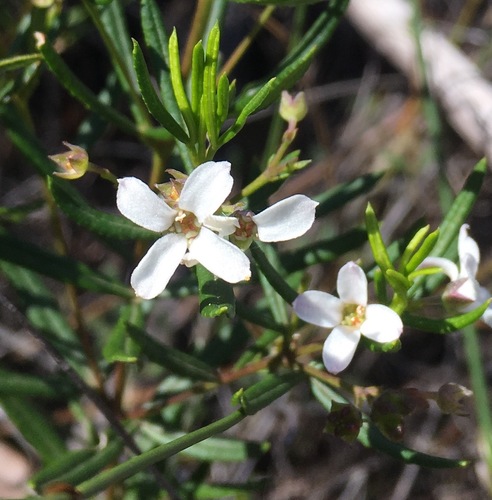
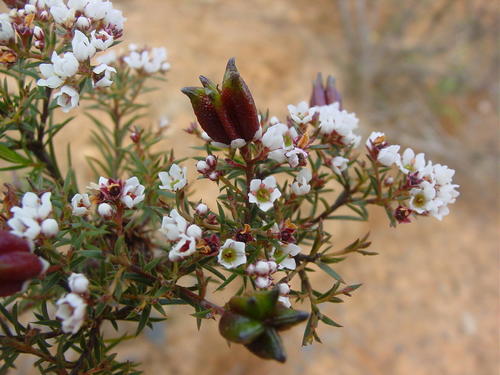
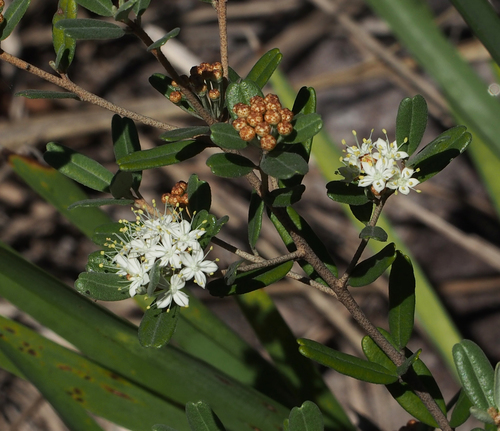
Phebalium squamulosum is most commonly a shrub that typically reaches a height of 3 m (9.8 ft), and sometimes grows as a slender tree up to 7 m (23 ft) tall. Its branchlets are smooth and covered in rust-coloured scales. The leaves are either papery or leathery, ranging in shape from linear to elliptical or egg-shaped with the narrower end at the base. They measure 7–70 mm (0.28–2.76 in) long and 1.5–8 mm (0.059–0.315 in) wide, growing from a petiole that is 0.5–4 mm (0.020–0.157 in) long. The upper surface of the leaves is more or less hairless, while the lower surface is covered in silvery to rust-coloured scales and star-shaped hairs. Between five and ten or more flowers are arranged in umbels at the ends of branchlets, with each flower growing on a pedicel 3–8 mm (0.12–0.31 in) long. The calyx is shaped from hemispherical to top-shaped, measuring 0.5–1.5 mm (0.020–0.059 in) long and 1.2–2 mm (0.047–0.079 in) wide; it is hairless on the inside and covered with scales on the outside. The petals are pale to bright yellow or cream-coloured, elliptical, and 2–4.5 mm (0.079–0.177 in) long, with silvery to rust-coloured scales on the back. The fruit is an erect follicle around 3.5 mm (0.14 in) long. This species, commonly called scaly phebalium, is widespread. It grows mainly in heath and forest on sandstone, and is found in northern and south-eastern Queensland, eastern New South Wales and eastern Victoria. In horticulture, Phebalium squamulosum is cultivated as an ornamental flowering shrub. It is frost tolerant and grows best in a well-drained, partially shaded location with a cool, moist root zone.