About Phazaca theclata Guenée, 1852
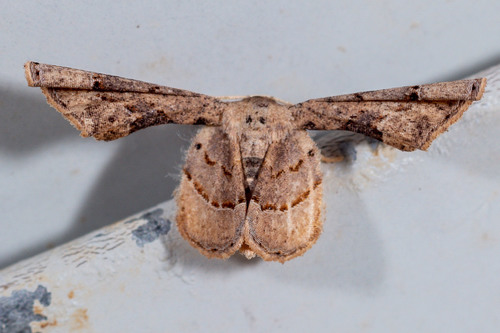
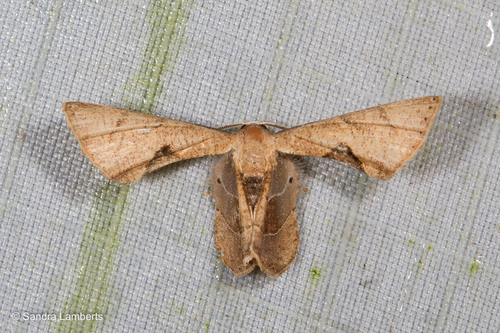
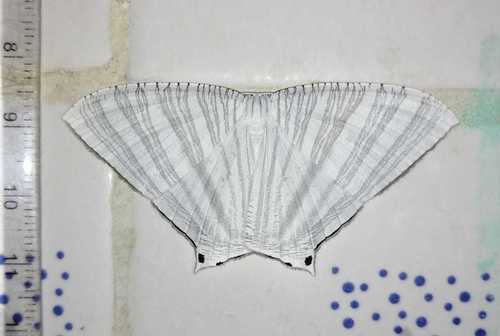
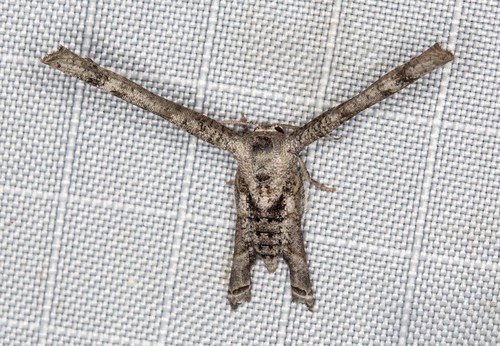
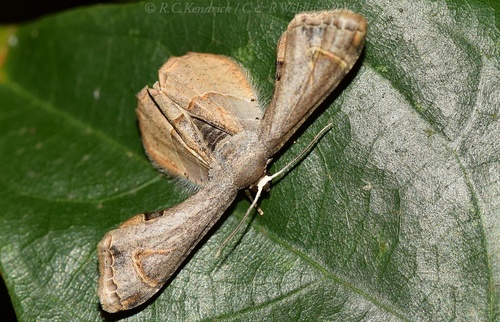
Phazaca theclata Guenée, 1852 has a wingspan of roughly 17–22 mm. Males of this species have slight tails on their hindwings at veins 4 and 7, with normal venation. For males, the antennae and vertex of the head are whitish, while the head and thorax are violaceous (violet) grey. The abdomen is ochreous, with the exception of its base. The forewings are violaceous grey; a large triangular patch outlined by a double brown line sits on the costa beyond the middle of the wing. A similar oval spot with a darker center is located on the inner margin, and a series of marginal fuscous lunules is present. The basal half of the hindwings is violaceous grey, darkest along the inner margin, while the outer half is pale ochreous brown. The two color areas are defined by a rufous and pale line, and the hindwings also bear a series of marginal fuscous lunules. Females have the same violaceous ground color on the abdomen and hindwings. The larva of Phazaca theclata feeds on a range of plant species, including multiple members of the family Verbenaceae, specifically Stachytarpheta urticifolia and Duranta erecta, as well as Adina cordifolia, Burttdavya nyasica, Morinda sp., Randia dumetorum, Tectona grandis, Paraserianthes falcataria, and Coddia rudis.