About Phaulacridium marginale (Walker, 1870)
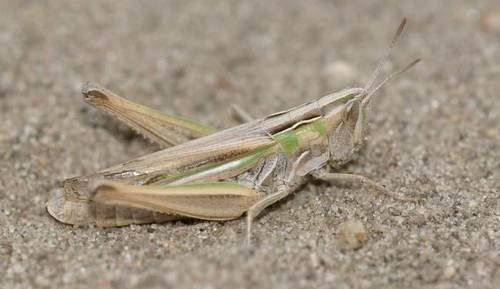
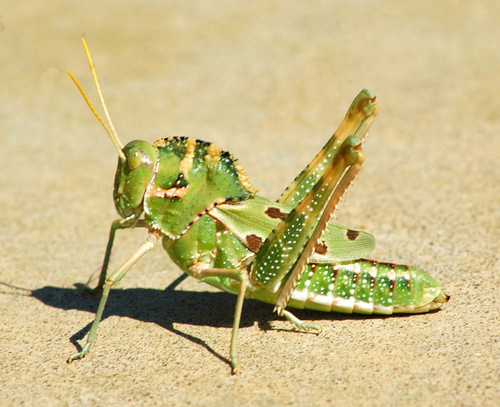
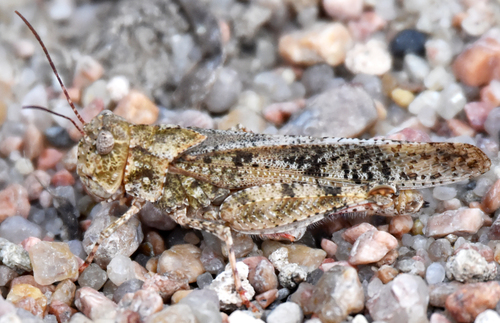
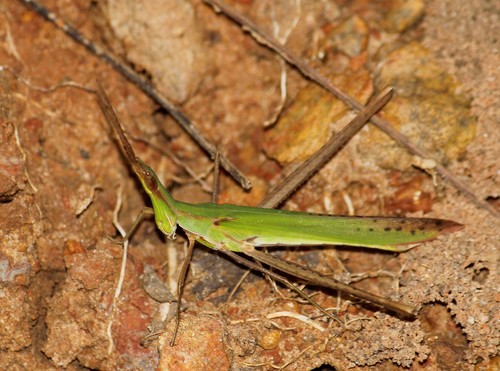
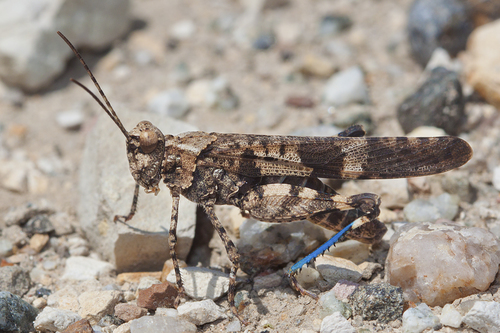
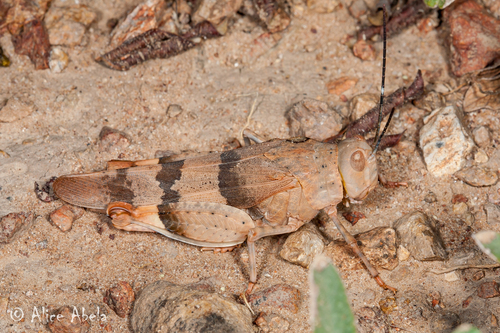
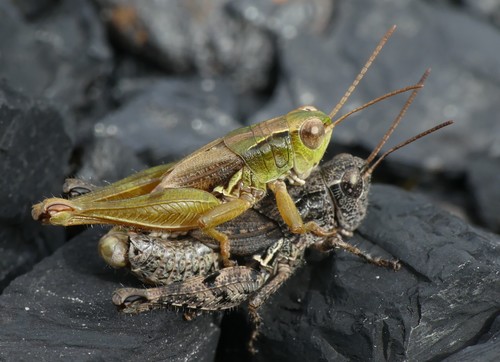
Phaulacridium marginale is a short-horned grasshopper species endemic to New Zealand. Most individuals of this species are micropterous, meaning they have small wings measuring between 1 and 3 millimetres, which makes the species flightless, similar to most New Zealand grasshoppers. Fully winged, macropterous adults are extremely rare, and occur across the entire country; only 89% of these rare fully winged adults are female, while 11% are male. The potential benefits of fully developed wings include escaping unfavorable local conditions to improve survival, colonizing new habitats, and escaping predators more effectively. It is currently unknown what triggers normally micropterous P. marginale to develop fully formed wings in New Zealand. One possible proposed trigger is high levels of environmental stress from harmful local conditions during an individual’s final instar stage. There is clear sexual dimorphism in body size for this species. Males have a body length between 10 and 15 millimetres, while females are larger, with a body length between 20 and 30 millimetres. P. marginale displays colour polymorphism, with two basic body pattern morphs: striped and unstriped. Unstriped individuals are most commonly brown. Striped individuals have white pigmented stripes with black edges along the dorsal and ventral surfaces of the abdomen and pronotum. Intermediate patterned morphs have also been recorded. Independent of these pattern variants, P. marginale also has variable overall body coloration that ranges from brown to green tones, with green coloration being less common. This species is widespread throughout all of New Zealand, and also occurs on many of the country’s offshore islands. Confirmed populations have been recorded on Little Barrier Island (Hauturu), Great Barrier Island (Aotea), the Hen and Chicken Islands, and the Chatham Islands, which sit around 850 kilometres east of mainland New Zealand; the species is also likely present on additional unrecorded offshore islands. It is most commonly found in open lowland grassy flats and sand dunes. It can also occur in the sub-alpine zone, up to an altitude of 1350 metres on the Ragged Range, located at 43°14′47″S 171°06′10″E. It is not an uncommon sight on roadsides with introduced exotic grass, and in built-up areas near the cities of Wellington and Christchurch. Members of the Phaulacridium genus prefer open habitats, where individuals can thermoregulate their bodies by basking, also known as sunning.