About Phasianus versicolor Vieillot, 1825
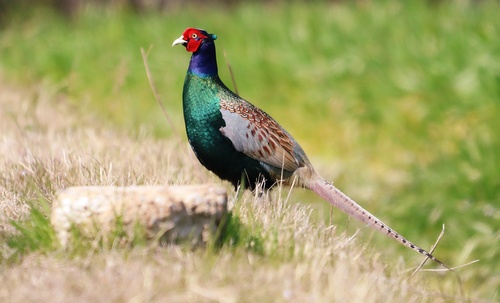
The species Phasianus versicolor Vieillot, 1825, commonly known as green pheasant, has three recognized subspecies, with consistent sex-based plumage and size differences that follow shared subspecies patterns. Male (cock) southern green pheasant, the nominate subspecies P. v. versicolor, has dark green plumage covering the breast, neck, mantle, and flanks. It also has a bluish-purplish hood, distinct clear ear tufts, red wattles, and a long pale grey-banded tail. This male nominate subspecies has the darkest overall plumage among all subspecies, with plumage that is mainly green. Female (hen) green pheasants are smaller than males, with shorter tails; female P. v. versicolor have brownish-black plumage, with dark brown feathers fringed in pale brown. Male Pacific green pheasant, the subspecies P. v. tamensis, has lighter plumage than the nominate subspecies, with feathers that show more purple and blue tones. Male northern green pheasant, the subspecies P. v. robustipes, has the lightest plumage of the three subspecies, and its crown and mantle are more bronze than the same regions in the other two subspecies. Females of all three subspecies look much more similar to each other than males do. Following the same pattern as males, female P. v. versicolor normally have the darkest plumage, while female P. v. robustipes have the lightest plumage. This species is native to Japan, where it occurs throughout Honshu, Shikoku, Kyushu, and some smaller Japanese islands. It inhabits a range of environments including woodlands, forest edges, brush, grassland, and parkland, and frequently visits farmlands and human settlements. Throughout its native range, this species is common and widespread. Green pheasants have been introduced as gamebirds: the introduction to Hawaii was successful, with stable introduced populations remaining there. The attempted introduction to North America was unsuccessful, though some game farms in North America have crossed green pheasants with common pheasants and released the hybrid birds. In Western Europe, introduced green pheasant populations have likely interbred with common pheasants for many years, and no pure green pheasants remain in that region today. Within green pheasant's native Japanese range, the species outcompetes introduced populations of common pheasant. While the two species are closely related, they have different ecological requirements, and the common pheasant is less well adapted to the local ecology of green pheasant's native range.