About Phasianella solida (Born, 1778)
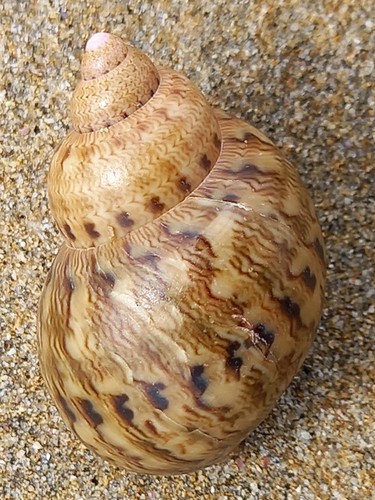
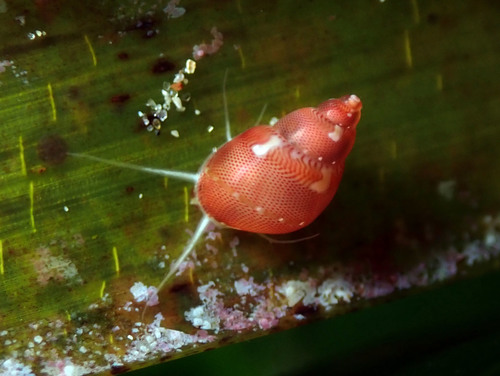
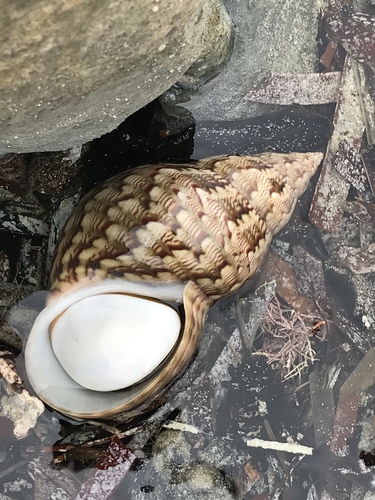
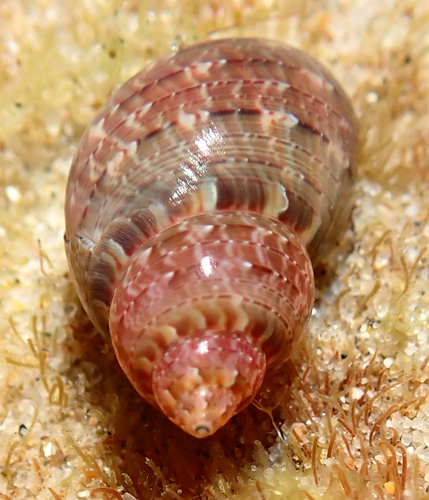
This species, Phasianella solida (Born, 1778), has been described under different previously recognized names with the following shell characteristics. For the form previously called Phasianella aethiopica, the shell size varies between 8 mm and 32 mm. The protoconch is smooth, and the fully formed shell is brilliant, elongated, thin, and turban-shaped. Shell color is usually pale brown, reddish, or pinkish, marked with variable blotches, and the shell has four to five rounded whorls. The operculum is white and oval-shaped. For the form previously considered Phasianella aethiopica, shell height ranges from 12 mm to 35 mm. The thick, solid shell has a pointed-ovate shape, with 5–6 moderately convex whorls that slope below the sutures. The oblique, ovate aperture makes up approximately half the total length of the shell. The thickened columella has a heavy white or rosy callus, and is subdentate near the posterior angle of the aperture. Shell color is light brown or rose, with revolving rows of arrow-shaped or irregular flecks of a lighter shade, or longitudinal oblique light stripes that extend downward to the middle of the body whorl. The apex and base of the shell are stained rose. For the form previously described as Phasianella variegata Lamarck, 1822, the solid shell grows to 2 cm in height and has an ovate-conic shape. Its pointed, conic spire is higher and more acute than the spire of Phasianella nivosa. The five somewhat convex whorls are separated by clearly marked sutures, and are somewhat flattened on the upper side. The rather small aperture is short and ovate, measuring less than half the total shell length. It is widely rounded below, and angular above. The columella has a flattened callus. The parietal wall has a more or less extensive white callus, and is noticeably thickened near the posterior angle. Shell color is variable: it is often pale with reddish-brown and white dashes and blotches, and is usually flesh-tinted, ashen, or brown, with more or less extensive clouding of darker and lighter shades. It is flammulated with dark and light markings below the sutures, and crossed spirally by narrow hair-like lines of brown or red, interrupted by white dots and intervals. White can sometimes be the dominant color on the shell. This quite common species occurs in the Red Sea, in the Indian Ocean off Madagascar, Tanzania, the Mascarene Basin, and the Aldabra Atoll, and across the tropical Indo-West Pacific, including off southern Australia, the Philippines, Java, and Japan. It lives in intertidal areas down to depths of up to 15 m.