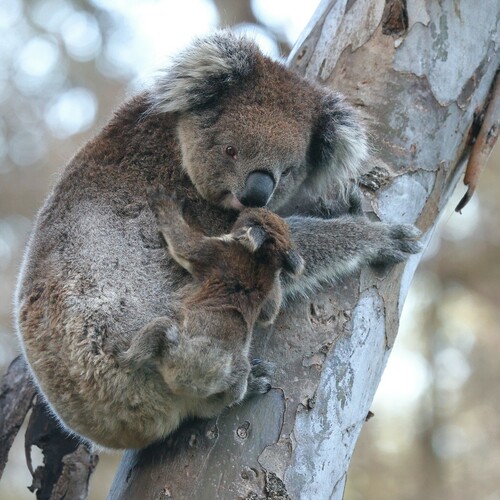
About Phascolarctos cinereus (Goldfuss, 1817)
The koala, scientifically named Phascolarctos cinereus (Goldfuss, 1817), is a robust marsupial with a large head and a vestigial or completely absent tail. It has a body length of 60–85 cm (24–33 in) and a weight of 4–15 kg (8.8–33.1 lb), placing it among the largest arboreal marsupials. Koalas from Victoria are twice as heavy as those from Queensland, and the species is sexually dimorphic: males are 50% larger than females. Males have more curved noses and bear chest glands that appear as visible bald patches. The opening of the female's pouch is held closed by a sphincter that keeps the young inside.
Koala fur is thicker on the back, and back fur colour ranges from light grey to chocolate brown. Belly fur is whitish, while rump fur has a mix of mottled whitish and dark patches. Koalas have the most effective insulating back fur of any marsupial, which makes them resilient to wind and rain, and their belly fur can reflect solar radiation. Koalas have curved, sharp claws well suited for climbing trees. Their large forepaws have two opposable digits — the first and second, which oppose the other three — allowing them to grip small branches. On the hind paws, the second and third digits are fused, a trait typical of members of Diprotodontia, and their separate attached claws work like a comb. Koalas have a robust skeleton and a short, muscular upper body with relatively long upper limbs that aid climbing. Their thigh muscles are anchored lower on the shinbone, which boosts their climbing power.
Compared to other mammals, koalas have a disproportionately small brain, 60% smaller than that of a typical diprotodont, with an average weight of only 19.2 g (0.68 oz). The brain's surface is fairly smooth and considered "primitive," and unlike most mammals, the brain does not completely fill the cranial cavity. Large amounts of cerebrospinal fluid lighten the brain, and this fluid may protect the brain if the koala falls from a tree. The koala's small brain may be an adaptation to the energy limits imposed by its diet, which cannot support a larger brain. A small brain limits the koala's ability to perform complex behaviours; for example, koalas will not eat plucked eucalyptus leaves placed on a flat surface, as this does not fit their normal feeding routine.
Koalas have a broad, dark nose with a good sense of smell, and they sniff the oils of individual eucalyptus branchlets to check if they are edible. Their relatively small eyes are unusual among marsupials because their pupils have vertical slits, an adaptation for living on a more vertical plane. Their round ears give them good hearing, and they have a well-developed middle ear. The koala larynx sits relatively low in the vocal tract and can be pulled further downward. In addition to the typical vocal folds of the larynx, koalas have unique folds in the velum (soft palate) called velar vocal folds. These features let koalas produce deeper sounds than would be expected for their body size.
Koalas have multiple adaptations for their diet of low-nutrient, toxic, fibrous eucalyptus leaves. Their teeth are made up of incisors and cheek teeth (one premolar and four molars on each jaw), separated by a large gap, a characteristic feature of herbivorous mammals. Koalas bite a leaf with their incisors, clip it at the petiole with the premolar, then chew it into pieces with cusped molars. Koalas may store food in their cheek pouches before chewing. The partially worn molars of prime-age koalas are ideal for breaking leaves into small particles, which allows more efficient stomach digestion and nutrient absorption in the small intestine, which provides most of the koala's energy from digesting eucalyptus leaves. A koala will sometimes regurgitate food into its mouth to be chewed a second time.
Koalas are hindgut fermenters, and food can stay in their digestive system for 100 hours in the wild or 200 hours in captivity. This long retention is enabled by their caecum, which is 200 cm (79 in) long and 10 cm (3.9 in) in diameter, possibly the largest caecum for any animal of its size. Koalas can keep food particles longer for fermentation when needed, and they are more likely to retain smaller particles, as larger ones take longer to digest. Although the hindgut is relatively large, only 10% of the koala's energy comes from digestion in this chamber. The koala's metabolic rate is only 50% of the typical mammalian rate, due to its low energy intake, though this rate can vary between seasons and between sexes. Koalas can digest the toxic plant secondary metabolites phenolic compounds and terpenes because their liver produces cytochrome P450, which neutralises these poisons. Koalas replace lost water more slowly than species like some possums, and they retain water by absorbing it in the caecum, which produces drier faecal pellets packed with undigested fibre.
The koala's current range covers approximately 1,000,000 km2 (390,000 sq mi) across 30 ecoregions in mainland eastern and southeastern Australia, including the states of Queensland, New South Wales, Victoria, and South Australia. They live in both tropical and temperate habitats, from dense woodlands to open forests. In semi-arid climates, they prefer riparian habitats, where nearby streams and creeks provide shelter during drought and extreme heat. Koalas have been introduced to several nearby islands, and the population on Magnetic Island marks the northern limit of their current range. Fossil evidence shows that during the late Pleistocene, koalas ranged as far west as southwestern Western Australia. They were likely driven to extinction in these areas by environmental changes and hunting by Aboriginal peoples. Koalas were introduced to Yanchep, Western Australia, in 1938, but this population had dropped to only 4 individuals by 2022.
Koalas are seasonal breeders, and give birth between October and May. When females are in oestrus, they lean their heads back and shake their bodies. Despite these clear signals, males attempt to copulate with any female during this period, mounting from behind. Because of the male's much larger size, he can overpower a female. A female may scream and forcefully fight off suitors, but will accept a male that is dominant or familiar. The commotion can attract other males, forcing the current male to delay mating and fight off intruders. A female can learn which male is more dominant during these fights. Older males typically have scratches, scars, and cuts on the exposed parts of their noses and their eyelids.
Koalas are induced ovulators. Gestation lasts 33–35 days, and a female gives birth to one joey (young koala), or occasionally twins. The newborn is tiny and barely developed, weighing no more than 0.5 g (0.018 oz). However, its lips, forelimbs, and shoulders are relatively advanced, and it can breathe, defecate, and urinate. The joey crawls into its mother's pouch to continue developing. Unlike most marsupials, female koalas do not clean their pouches. The joey latches onto one of the female's two teats to suckle. The female lactates for up to a year to compensate for her low energy production. Unlike other marsupials, koala milk becomes less fatty as the joey grows.
After seven weeks, the joey has a proportionally large head, clear edges around its face, more colour, and a visible pouch (if female) or scrotum (if male). At 13 weeks, the joey weighs around 50 g (1.8 oz), its head has doubled in size, its eyes begin to open, and fur starts to grow. At 26 weeks, the fully furred joey resembles an adult and can look outside the pouch. At six or seven months old, the joey weighs 300–500 g (11–18 oz) and fully emerges from the pouch for the first time. It explores its new surroundings carefully, clinging to its mother for support. Around this time, the mother prepares the joey for an eucalyptus diet by producing a faecal pap from her caecum, which the joey eats from her cloaca. This pap is more liquid than regular faeces and filled with bacteria. A nine-month-old joey has its adult coat colour and weighs 1 kg (2.2 lb). After permanently leaving the pouch, it rides on its mother's back to travel and learns to climb by grasping branches. It gradually becomes more independent. The female becomes pregnant again one year after her previous offspring is born, once the offspring weighs around 2.5 kg (5.5 lb). She permanently ends her bond with the previous offspring and stops allowing it to suckle, but the offspring stays nearby until it is one-and-a-half to two years old.
Females reach sexual maturity at around three years of age, while males reach sexual maturity at around four years, though males can start spermatogenesis as early as two years old. Males do not start marking with their scent until they reach sexual maturity, even though their chest glands become functional much earlier. Koalas can breed every year if environmental conditions are good, but the long period of young dependence on their mothers usually leads to one-year gaps between births.

