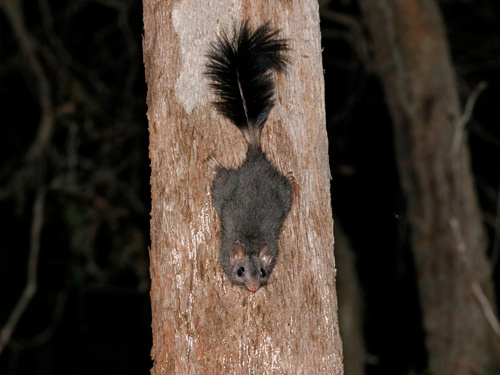
About Phascogale tapoatafa (Meyer, 1793)
Phascogale tapoatafa, the brush-tailed phascogale, has a grey body. Its lower half of the tail is covered in long black hairs that can stand erect, giving the tail a bottle-brush-like appearance. Body length ranges from 16 to 27 cm (6.3 to 10.6 in), and the tail measures between 16 and 24 cm. Males are larger than females, growing up to 310 grams (11 oz), while females typically weigh less than 210 g. This species has a widespread but fragmented distribution across every Australian state except Tasmania. Due to habitat destruction and predation by red foxes and feral cats, the brush-tailed phascogale is thought to have been lost from approximately half of its former range. It is considered highly vulnerable to localized extinction. In New South Wales, it is listed as a vulnerable species on Schedule 2 of the 1995 Threatened Species Conservation Act (TSC Act). The IUCN Red List, however, classifies it as near threatened, and it holds no protected status under the EPBC Act. Breeding takes place between June and August, when females enter estrus. Almost all wild male brush-tailed phascogales die before they reach one year of age, typically from stress-related illnesses caused by the high energy expenditure of intense mating activity. A small number of captive males have survived to age three, but these males became reproductively non-viable after their first year. Females nest inside tree hollows, and give birth to litters of 7 to 8 young that remain in the nest until they are 5 months old.