About Pharomachrus mocinno La Llave, 1832
The resplendent quetzal, Pharomachrus mocinno, is the largest member of the trogon family. Its body length measures 36 to 40 cm (14–16 in). In the nominate subspecies, male tail streamers range from 31 cm (12 in) to 100.5 cm (39.6 in), with a median length of 75 cm (30 in). The nominate subspecies weighs approximately 210 g (7.4 oz). The subspecies P. m. costaricensis is slightly smaller than the nominate race, with shorter wings and bills. Its tail plumes are also shorter and narrower, ranging between 32 cm (13 in) and 86 cm (34 in), with a median length of 63 cm (25 in).
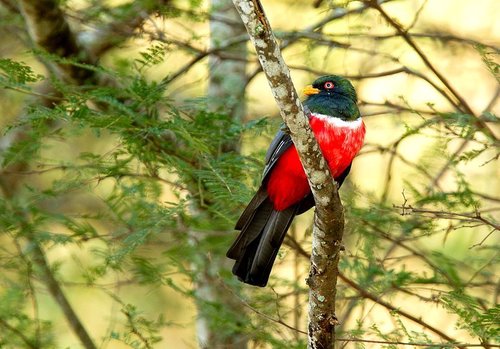
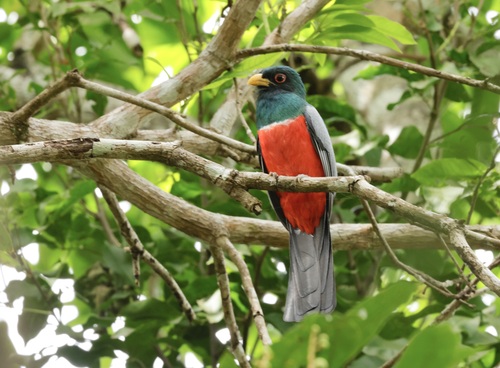
Resplendent quetzals have a green body that shows iridescence ranging from green-gold to blue-violet, and their lower breast and belly are red. Depending on light conditions, their feathers can shine in a range of colors from green, cobalt, lime, and yellow to ultramarine. Their green upper tail coverts hide their tails; these coverts are especially striking in breeding males, and are longer than the rest of the bird's body. While the quetzal's plumage appears green, the plumage is actually brown from the pigment melanin. The bird's primary wing coverts are also unusually long and have a fringed look. Males have a helmet-like crest. The bill is partially covered by green filamentous feathers; it is yellow in mature males and grey in females. The iridescent feathers that give the quetzal a shiny green appearance matching canopy leaves are a camouflage adaptation, allowing it to hide within the forest canopy during rainy weather. The quetzal has very thin skin that tears easily, so it has evolved thick plumage to protect this delicate skin. It also has large eyes adapted for vision in the dim light of forests. Its song is a sequence of full-toned, mellow, slurred notes in simple patterns, and is often noticeably melodious, with sounds commonly transcribed as keow, kowee, keow, k'loo, keeloo.
This species lives in lush vegetation, specifically in moist high-elevation rainforests between 900–3,200 m (3,000–10,500 ft). It occupies trees that form the rainforest's canopy and subcanopy, though it can also be found in ravines and on cliffs. It prefers to live in decaying trees, stumps, and abandoned woodpecker hollows. The quetzal's bright colors are hidden by the rainforest environment. The resplendent quetzal's range extends from southern Mexico (the southernmost parts of Oaxaca and Chiapas) to western Panama (Chiriquí). The two subspecies have separate ranges: P. m. mocinno occurs in southern Mexico, northern El Salvador, northwestern Nicaragua, Guatemala, and Honduras, while P. m. costaricensis occurs in Costa Rica and western Panama. The geographical separation between the two subspecies is caused by the Nicaraguan depression, a 50 km (31 mi) wide, 600 km (370 mi) long lowland area that holds Central America's two largest lakes, Lake Managua and Lake Nicaragua, as well as a lack of suitable breeding habitat in adjacent regions. After the breeding season, the quetzal migrates from its breeding grounds in lower montane rainforest to pre-montane rainforest on Pacific slopes, where it stays for three to four months from July to October. After this period, it moves across the continental divide to Atlantic slopes. Quetzal abundance in mating areas correlates with the total number of fruiting plant species, while the correlation between quetzal abundance and the number of fruiting Lauraceae species is only weak.