About Pharomachrus fulgidus (Gould, 1838)
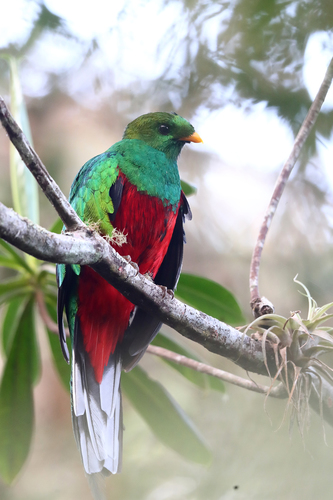
Morphology: Adult male white-tipped quetzals can be identified by a golden green-bronze crown and nape, paired with bright green coloring on the breast, back, rump, and upper tail-coverts. Males have butter-yellow bills and brownish-black feet. Their under tail-coverts and belly are a striking red, while their wings and upper tail are black; their under tail appears white, which gives the species its 'white-tipped' common name. These broad, white-tipped outer rectrices have white coloring that covers roughly one third of their length. Males also have elongated feathers on the forehead that form a short crest. The white tips of the outermost rectrices measure 50 mm long, the next set measure 55 mm, and the following set measure 32 mm long. Adult females have less iridescent plumage than males, lack a frontal crest, and have brown-grey coloring on the throat, belly, and breast that is bordered by a green band. Females have yellowish-brown to grey bills and feet, and their three outermost rectrices also have narrow white tips. In immature birds of both sexes, chicks have remiges, scapulars, and wing coverts that are intermixed with buff. Their outer rectrices have white coloring throughout, and their feathers are narrower and more pointed than those of adult birds. Immature females have brown breasts. Trogons are the only group of birds with a heterodactyl toe arrangement. Habitat: The white-tipped quetzal is found in Colombia, Venezuela, and Guyana, and is endemic to northern South America. In Colombia and Venezuela, it occurs in upper tropical and subtropical zones. The species lives in a wide variety of habitats, including subtropical to temperate forests, cloud forests, secondary growth, forest edges, moist ravines, and coffee plantations. Like golden-headed quetzals and crested quetzals, white-tipped quetzals are considered cloud forest birds. They are rarer in Guyana, where they have only been observed inhabiting the densest areas of forest barrancas, or deep ravines. Because there have been so few observations of this species, it is not known why it favors these environments, but it is likely due to the areas' temperate, humid conditions, available berries, and small crevices that can be used for nesting. Population size and distribution: The white-tipped quetzal is endemic to the Americas. In Venezuela, the species occurs at altitudes between 900 and 1900 m, ranging across the coastal cordillera from Yaracuy to Miranda, the middle cordillera on Cerro Golfo Triste, and the eastern cordillera in Anzoátegui, northern Monagas, and Sucre, extending east to Cerro Humo. It also occurs at altitudes of 1500 to 2500 m in Colombia's Santa Marta mountains, in the Sierra Nevada. One individual was recorded at an elevation of 725 to 775 m in a coffee plantation in Cucuchica, Venezuela, which indicates the species has a larger distribution than currently documented. The white-tipped quetzal is also native to Guyana, but its population status and distribution there are unclear and have not been documented. This is likely because the species lives in the most remote, dense forest barrancas in the region. While it has the smallest geographic distribution of any quetzal, it is fairly common within the areas it does inhabit. No specific total population counts have been published because there have been few formal studies of the species. Ecology: Breeding occurs mostly toward the end of the dry season, between January and April. It is thought that the quetzal's reproductive cycle is directly linked to fruit availability: courtship, nesting, and chick rearing all take place when fruits are most abundant in forest habitats. This supports the species during the energy-intensive stages of reproduction, which may increase the chance of breeding success. White-tipped quetzal nests are most often built in isolated, non-native trees, sometimes in abandoned woodpecker holes, and are usually located in dead tree trunks 4 to 10 meters above the ground. One nest has been observed in an old woodpecker-excavated cavity in a dead snag roughly 5 meters above the ground at 1600 m elevation. The species can also nest in termite nests. Females lay 2 to 4 white or pastel-colored eggs, and there are small differences in egg color and size between individuals. Individuals usually breed for the first time when they are one to two years old. The altricial young hatch naked, and molt quickly into immature plumage without going through a distinct downy stage. This rapid transition from naked to feathered may be an ancestral trait, or an adaptation to cavity nesting: because cavity temperatures stay consistent, down is not needed for temperature regulation. Young white-tipped quetzals fledge around three weeks after hatching, and develop full adult plumage after their second prebasic molt. There is little data on the survival rates and competition of the white-tipped quetzal, but its IUCN assessment indicates that the overall population is stable.