About Phallusia nigra Savigny, 1816
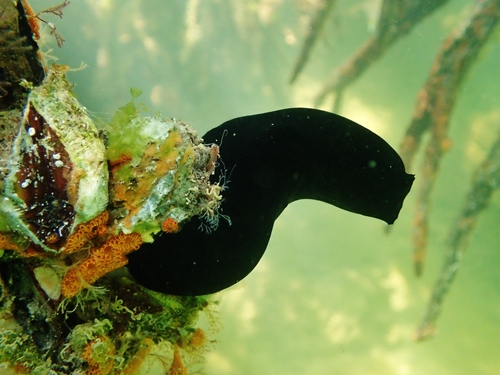
Phallusia nigra is a solitary marine tunicate that belongs to the ascidian class. It is found in tropical seas worldwide, and typically lives in shallow waters attached to hard substrates. Like all tunicates, P. nigra has a thick, leathery cellulose-containing envelope called a tunic. Like all solitary ascidians, this tunic surrounds a sac-shaped body that has two separate water siphons: one for water entrance and one for water exit. P. nigra feeds on plankton, which it filters out of seawater using a mucous net. This tunicate is frequently a host for the small symbiotic pea crab Tunicotheres moseri, which lives inside the tunicate's atrial chamber. Adult P. nigra can reach 10 cm (4 inches) in length. Its tunic is most often velvet black or dark brown, though younger specimens and specimens from shaded areas may have gray tunics. P. nigra's original native range is not clear; the tropical Western Atlantic Ocean, the Red Sea, and the Indian Ocean have all been proposed as possible original ranges. The tunic of P. nigra holds many vesicles filled with a strong acid that has a pH near 1. This acid contains mostly sulfate (SO42−) and chloride (Cl−) anions. The vesicles are concentrated near the outer surface of the tunic and break easily when touched; they are thought to protect P. nigra from predation and fouling. Methanol-extracted substances from dried P. nigra tunics have been found to have cytotoxic, antibacterial, antipyretic, analgesic, and histamine-like activity.