About Phallus indusiatus Vent.
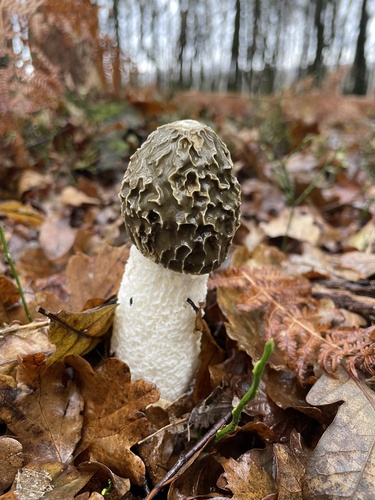
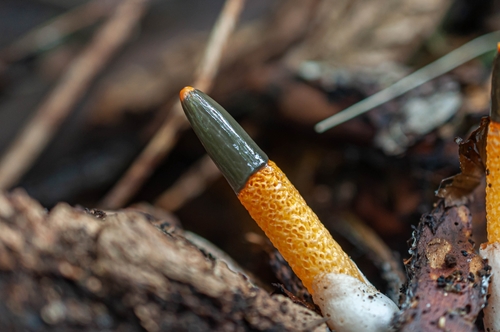
Immature fruit bodies of Phallus indusiatus are initially enclosed in an egg-shaped to roughly spherical subterranean structure wrapped in a protective peridium. This "egg" ranges in color from whitish to buff to reddish-brown, measures up to 6 centimetres (2+1⁄4 inches) in diameter, and usually has a thick mycelial cord attached at its base. As the mushroom matures, pressure from the enlargement of internal structures tears the peridium, allowing the fruit body to rapidly emerge from the "egg".
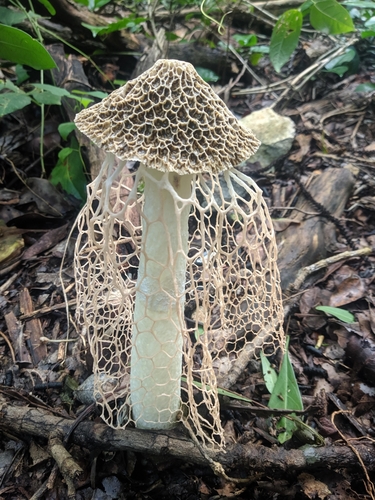
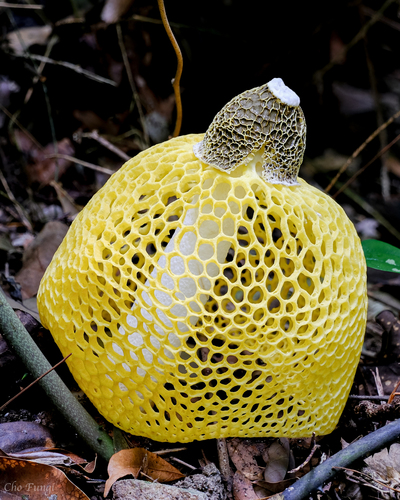
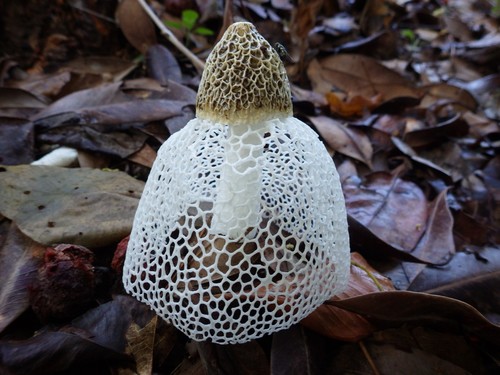
The mature mushroom reaches up to 25 cm (10 in) tall, and features a net-like structure called the indusium (colloquially called a "skirt") that hangs around the mushroom from its conical to bell-shaped cap. The net openings of the indusium may be either polygonal or round. Well-developed specimens have an indusium that extends all the way down to the volva, and flares out somewhat before collapsing onto the stalk. The cap is 1.5–4 cm (1⁄2–1+1⁄2 in) wide; its reticulated (pitted and ridged) surface is covered with a layer of greenish-brown, foul-smelling slime called gleba, which initially partially obscures the cap's reticulations. There is a small hole at the top of the cap. The stalk is 7–25 cm (3–10 in) long, and 1.5–3 cm (1⁄2–1+1⁄4 in) thick. It is hollow, white, roughly consistent in width along its length, sometimes curved, and spongy in texture. The ruptured peridium remains as a loose volva at the base of the stalk.
Fruit bodies develop overnight, with very rapid growth. Between 7 and 8 am solar time, it can grow to a height of 12.5 cm (4.9 in) in a single hour, and reaches 21 cm (8.3 in) by 9 am. After emerging from the peridium, the fungus requires 10–15 hours to fully develop. Fruit bodies are short-lived, typically lasting no more than a few days. By this point, the gleba slime has usually been removed by insects, leaving the pale off-white, bare cap surface exposed. The spores of Phallus indusiatus are thin-walled, smooth, elliptical or slightly curved, and hyaline (translucent), measuring 2–3 by 1–1.5 μm.
Phallus indusiatus has a tropical distribution. Its known range includes Africa (Congo, Nigeria, Uganda, Zaire), South America (Brazil, Guyana, Venezuela), Central America (Costa Rica), and Tobago. In North America, it is only found in Mexico. In Asia, it has been recorded in Indonesia, Nepal, Malaysia, India, Southern China, Japan, and Taiwan. It has also been collected in Australia.
Like all species in the genus Phallus, P. indusiatus is saprobic, meaning it gets nutrients by breaking down wood and plant organic matter. Its fruit bodies grow singly or in groups on disturbed ground and among wood chips. In Asia, it grows in bamboo forests, and typically produces fruit bodies after heavy rains.
The reproductive method of stinkhorns (including P. indusiatus) differs from most agaric mushrooms, which forcibly eject their spores. Instead, stinkhorns produce a sticky spore mass with a sharp, sickly-sweet carrion odor. The strong cloying scent of mature fruit bodies, detectable from a considerable distance, attracts certain insects. Recorded insect visitors to the fungus include stingless bees of the genus Trigona, and flies from the families Drosophilidae and Muscidae. Insects help disperse the fungus's spores by consuming the gleba and excreting intact spores that can germinate in new locations. While the exact function of the indusium is not definitively known, it may visually attract insects that would not otherwise be drawn to the fungus by odor, and act as a ladder for crawling insects to reach the gleba.
Medicinal properties have been attributed to Phallus indusiatus in a Chinese Tang dynasty pharmacopoeia. The fungus was historically used to purportedly treat inflammatory, stomach, and neural diseases. The Miao people of Southern China continue to use it traditionally for a number of ailments. It is prescribed in Traditional Chinese Medicine to treat laryngitis, leucorrhea, fever, oliguria (low urine output), diarrhea, hypertension, cough, hyperlipidemia, and is used as part of anticancer therapy.