About Phallus hadriani Vent.
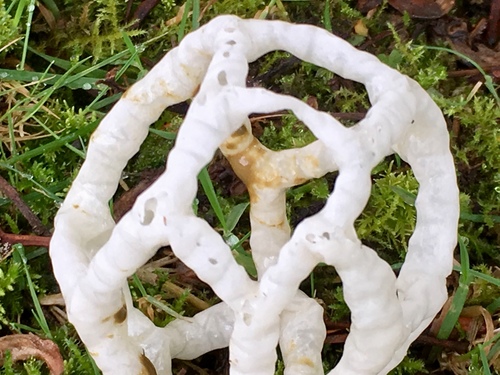
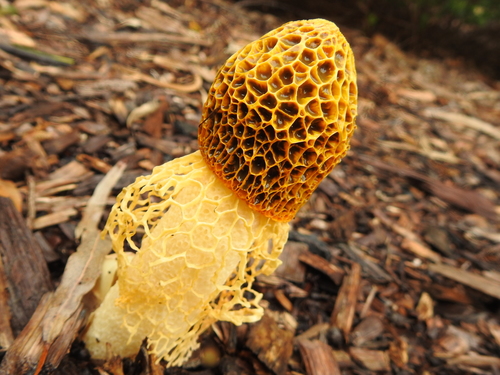
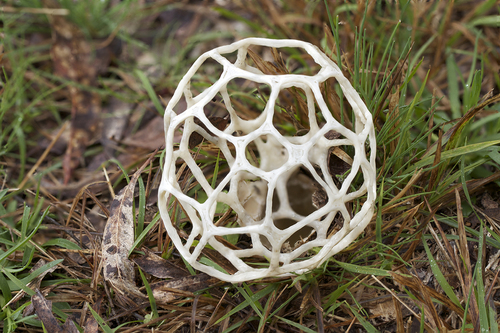
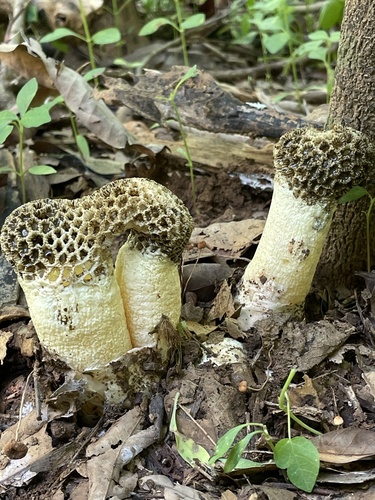
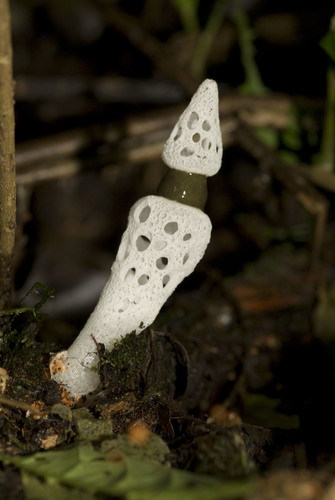
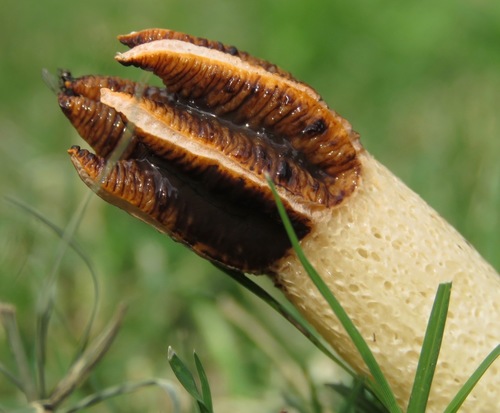
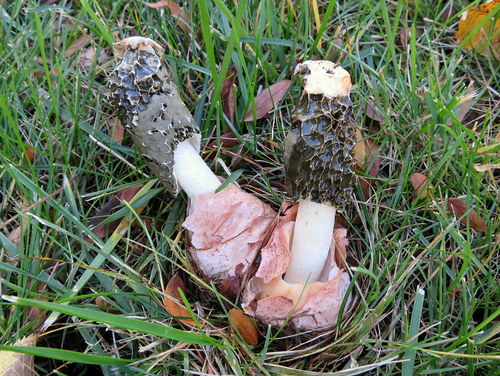
Immature egg-stage fruiting bodies of Phallus hadriani measure 4 to 6 cm (1+1⁄2 to 2+1⁄4 in) by 3 to 4 cm (1+1⁄4 to 1+1⁄2 in), and range in color from rosy-pink to violet. They are usually submerged underground, with rhizomorphs (mycelium aggregations that resemble plant roots) at their base. The eggs are enclosed by a tough outer covering and a gelatinous inner layer, both of which break down as the stinkhorn fruiting body emerges. Mature fruiting bodies can reach 10 to 20 cm (4 to 8 in) tall and 3 to 4 cm (1+1⁄4 to 1+1⁄2 in) thick. The stipe is white or cream-colored, up to 3 cm wide, hollow, spongy, and honeycombed. The apical head is reticulate (marked by ridges and pits), and covered in an olive green spore-containing glebal mass. The cuplike volva (the remains of the outer egg covering) typically retains its pink color, though it may turn brownish as it ages. Fruiting bodies are short-lived, usually only lasting one or two days. Authors disagree on the odor of Phallus hadriani: some describe it as faint and pleasant, or similar to the scent of violets, while others report it as fetid or putrid. The gleba attracts insects including flies, bees, and beetles; some of these insects consume the spore-containing slime. It is thought that these insects facilitate long-distance spore dispersal, as intact spores can survive passage through the insects' digestive tracts and are deposited in insect feces. The spores are cylindrical, smooth, and hyaline (translucent), with dimensions of 3–4 by 1–2 μm. The spore-bearing basidia are cylindrical, measuring 20–25 by 3–4 μm. Each basidium has eight slender spore-holding extensions called sterigmata, plus a clamp connection at its base. Phallus hadriani has been recorded in Australia (where it is thought to be an introduced species brought in with woodchip mulch for gardening and landscaping), North America, Europe (including Denmark, Ireland, Latvia, The Netherlands, Norway, Poland, Slovakia, Sweden, Ukraine, and Wales), Turkey's Iğdır Province, Japan, and China's Jilin Province. This is a saprobic species, meaning it gets nutrients by decomposing organic matter. In North America, it is commonly associated with decomposing tree stumps or buried stump roots. In Great Britain, its distribution is roughly restricted to coastal dunes. In Poland, it has been observed avoiding humid, humus-rich forest soils, and growing in symbiosis with xerophilous (drought-tolerant) grasses and the black locust tree, Robinia pseudoacacia. This mushroom is one of three species protected by the Red Data Book of Latvia.