About Phalera bucephala Linnaeus, 1758
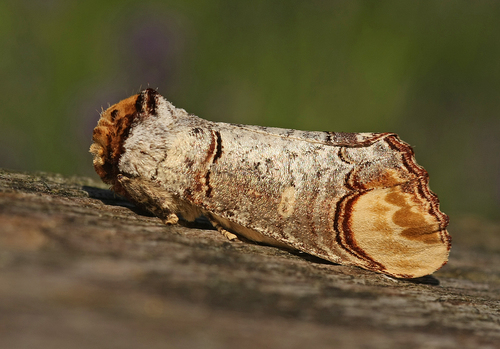
Phalera bucephala Linnaeus, 1758 is a fairly large, heavy-bodied moth species with a wingspan of 55–68 mm (2.2–2.7 in). Its forewings are grey, with a large, prominent buff patch at the apex. Combined with the buff thoracic hair, the moth resembles a broken twig when at rest. The hindwings are creamy white. A more detailed morphological description from Seitz notes: the head, collar and centre of the thorax are brownish yellow; patagia are greyish white with a black-brown double basal edge, with 2 black-brown transverse lines on the transverse crest, and the hind margin is greyish white. The abdomen ranges from yellowish grey to yellowish brown. The forewing is greyish brown, broadly white at the base and along the hind margin, with a prediscal dark brown and black double band. A large oval yellow patch at the apex reaches down to vein 4, is bordered proximally by a dark red-brown semicircle, and is traversed below the apex by a broad dentate dull ochreous submarginal spot. The black postdiscal band is semicircular on the costal half, parallel to the dark border of the apical patch, and becomes dentate beyond that, accompanied on the outer side by a dark brown line. The discal spot is whitish; the scaling has a strong silky gloss, except on the apical patch. The hindwing is whitish grey, with only a very faint indication of a dark median band. On the underside, both wings have a prominent black-brown discal band, and the forewing additionally has a black-brown marginal line. This species is distributed across most of Europe, excluding the Arctic Region and Greece; it is also found in North-East Africa, Asia Minor, and Siberia extending to East Asia. In Central Europe, it is abundant everywhere in May and June; a second brood in July and August occurs regularly only in the southern part of the region. Several variants and subspecies are recorded: The dark subspecies P. b. tenebrata Strand, 1903 occurs in Norway, Southern Sweden, and England. In this form, the white colouring of the forewing is more or less strongly reduced, particularly in the median area, while the hindwing is pale or dark grey. The aberration ab. demaculata Strand additionally lacks the pale discal spot of the forewing. The taxon bucephalina Stgr., now recognized as the separate species Phalera bucephalina (Staudinger & Rebel, 1901) that replaces P. bucephala in Western Morocco, is distinguished by darker ground colour, a more prominent discal spot, and a larger apical patch—characters that bring it closer to the species Phalera bucephaloides. The East Asian subspecies P. b. infulgens Graeser, 1888, common in the Amur and Ussuri districts, has an entirely uniformly whitish grey forewing without gloss, with the anterior half barely darker than the hind margin, and a somewhat narrower hindwing. The egg of Phalera bucephala is strongly convex, green, with a darker top and paler base. The larva is orange yellow, with a glossy black head, yellowish grey hair, and black longitudinal stripes interrupted between the segments. There are 5 stripes dorsally and 2 laterally; black spiracles are located between the two lateral stripes. The underside is black with a broad yellow median stripe; the abdominal legs are black on the outside and yellow on the inside. Larvae occur from June to October, feeding on Salix, poplar, birch, lime, and oak. The pupa is glossy black-brown, and may sometimes hibernate twice. Adult moths fly at night in June and July, and sometimes come to light, though they are not generally strongly attracted to it. Young larvae are gregarious, and become solitary as they grow. Fully developed older larvae are very distinctive, being black with white and yellow lines. The species feeds on a wide range of trees and shrubs, and overwinters as a pupa. Recorded food plants, as documented in detail by Robinson et al., 2010, include: Acer (Norway maple), Betula (birch), Castanea (chestnut), Corylus (hazel), Ribes (currant), Laburnum, Populus (poplar), Prunus, Quercus (oak), Robinia, Rosa (rose), Salix (willow), Tilia (lime), Ulmus (elm), and Viburnum.