About Phalangium opilio Linnaeus, 1758
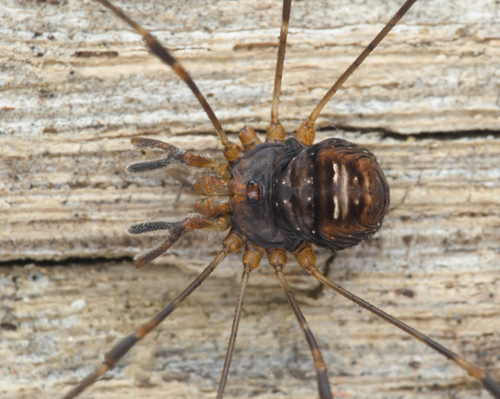
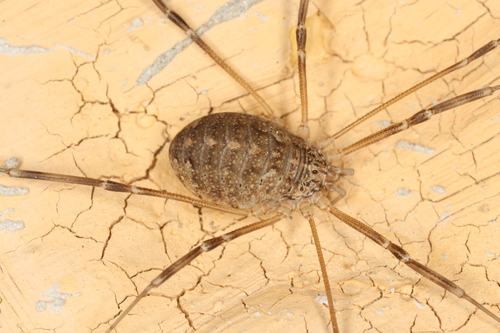
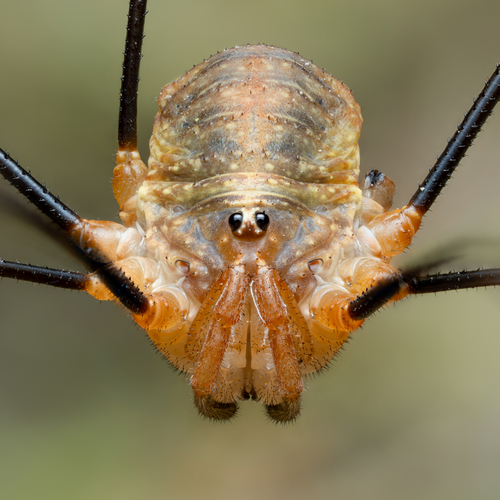
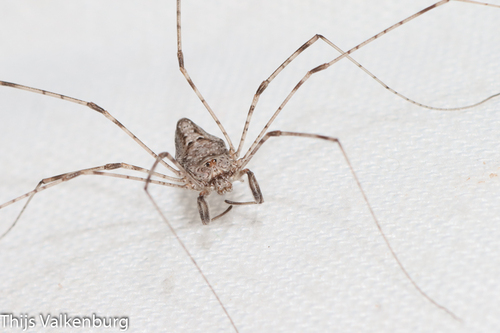
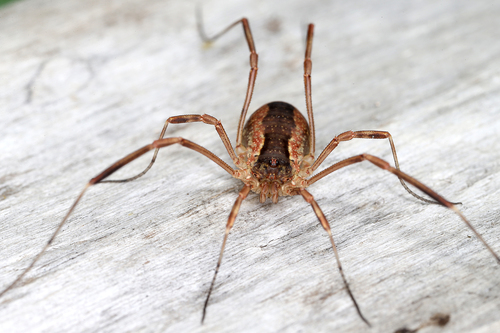
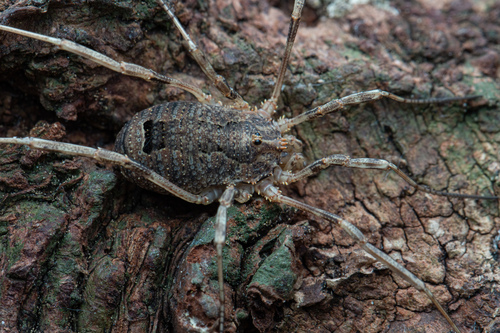
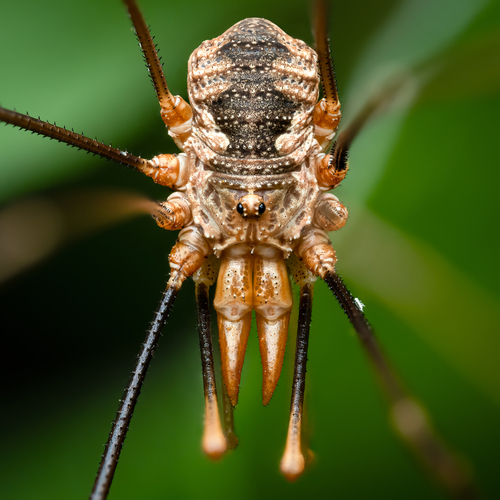
Like other harvestmen, Phalangium opilio has long, slender legs and a short, round body. Adult individuals have a body length of 3.5–9 mm (1⁄8–3⁄8 in). Males tend to have smaller bodies than females, but have noticeably larger pedipalps and chelicerae, with prominent horn-like outgrowths on the dorsal side of the second segment. Both sexes share similar colouration, marked with light brown and gray, and often have a light cream underside. P. opilio is relatively large compared to other harvestman species. Spines cover the legs, bodies, and eye tubercles of individuals of both sexes. Males can be distinguished from females by their longer pedipalps and the presence of long, forward-pointing horn-like processes on the second segment of their chelicerae. In some European populations, male chelicerae and pedipalpal size shows significant allometric variation, but it remains unclear whether this variation is continuous or discrete, which would indicate male dimorphism in P. opilio. As an arachnid species, P. opilio has four pairs of legs. Three of these pairs are used for movement, while the longest second pair is shaped like an antenna and primarily functions as a sensory appendage to feel the surrounding environment. The tarsus, the leg segment furthest from the body, has numerous pseudosegments called tarsomeres that make the legs prehensile. This allows P. opilio to use its legs for climbing (by curling them around twigs), courtship, and male-male combat. The legs have seven segments, while pedipalps have six. P. opilio has a mostly Holarctic distribution, and is the most widespread harvestman species worldwide. It is native to Europe, North and Central Asia, and Asia Minor. The species has been introduced from Europe to North America, North Africa, and New Zealand. In North America, it occurs in non-desert regions of southern Canada and the United States. This species can be found in a wide range of open habitats, including meadows, bogs, and forests. It is most abundant in anthropogenic habitats, so it is considered a synanthropic harvestman species. It can be found in human-modified habitats such as gardens, agroecosystems, hedgerows, lawns, quarries, urban green spaces, walls, and bridges. In agricultural settings, P. opilio is common in temperate cropland, living among crops such as corn, alfalfa, small grains, potatoes, cabbage, strawberries, and apples. P. opilio apparently prefers vertical surfaces, including tree trunks and vertical man-made structures like fences and walls. It prefers wood substrate due to wood's low thermal conductivity and slow moisture release; the species is thermophilous and moderately hygrophilous. However, its preference varies based on the amount of cover available in an area. When sparse shrub cover exists, P. opilio tends to be found in shrubs and brushy vegetation, but when dense cover such as low vegetation and grass is present, it tends to be found on the ground layer. Early instars (immature P. opilio) mostly occur on the ground, but later instars have a broader vertical range. P. opilio has also been observed taking cover in low vegetation like grass during rain. Eggs are laid in moist areas and hatch in three to five months. Juveniles undergo several molts and reach maturity in two to three months. Both egg hatching time and juvenile maturation time vary based on temperature; embryo development is fastest between 20–30 °C (68–86 °F), and stops completely below 10 °C (50 °F). Phalangium opilio is a univoltine species in Europe, producing one generation per year that overwinters as eggs. Two or more generations may occur per year in some areas of North America, and in these regions, eggs, immatures, and adults may all overwinter. For example, in Central Europe, one generation matures per year in early summer and late autumn. In contrast, in Kentucky, the species apparently undergoes three generations per year, and overwinters in the egg stage. In US populations, diapause (overwintering) is not a requirement for hatching; Wisconsin populations of P. opilio have been maintained in captivity with a continuous life cycle, which underpins their use for the study of developmental biology and comparative genomics. Like other harvestman species, male and female P. opilio copulate with multiple partners to achieve internal fertilization, and males produce aflagellate sperm. The mating season of P. opilio is three months long, based on studies in the cold humid Dfb Köppen–Geiger climate subcategory. When introduced to each other in a laboratory setting, male and female individuals usually mate within a few seconds of contact. Female specimens lay one clutch approximately every three days. In the captive colony observed, colonies overwintered and produced new adult females that bred and laid eggs in winter. The adult lifespan of P. opilio is 40 to 60 days long. The specimens used for these observations were collected from the U.S. states of Massachusetts and Wisconsin during their breeding season from early June to early September, and kept in a container at 26 °C (79 °F) with moist coconut fiber, food, and water.