About Phalacrocorax nigrogularis Ogilvie-Grant & H.O.Forbes, 1899
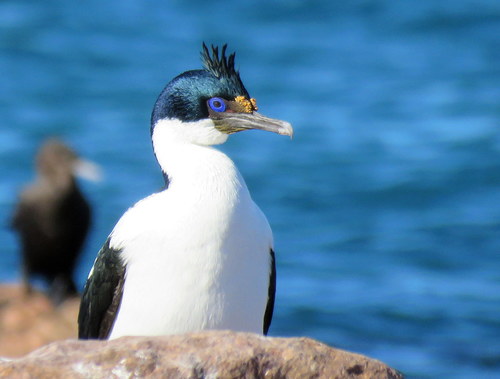
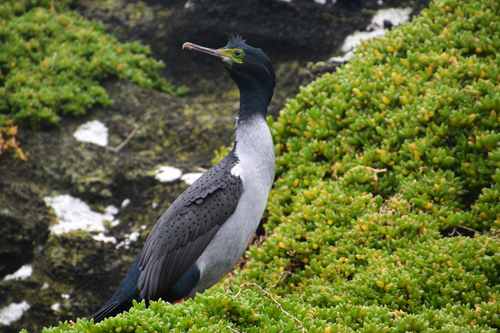
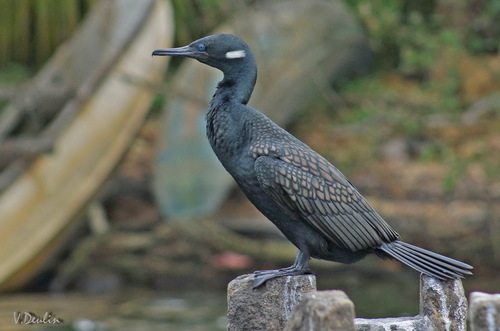
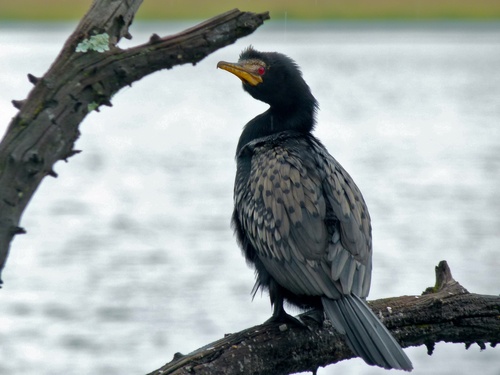
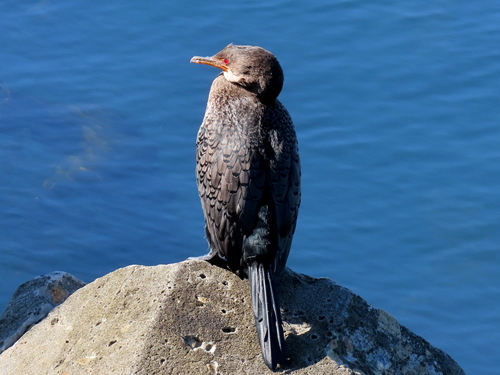
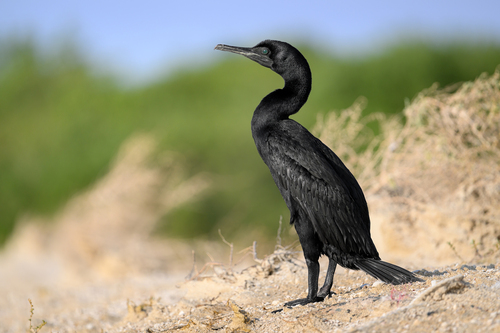
The Socotra cormorant, scientifically named Phalacrocorax nigrogularis, is a threatened cormorant species endemic to the Persian Gulf and the southeast coast of the Arabian Peninsula. It is sometimes called the Socotran cormorant, and more rarely the Socotra shag. Individual birds sometimes migrate as far west as the Red Sea coast. Despite its common name, breeding of this species on the Socotra islands in the Indian Ocean was only confirmed in 2005. The Socotra cormorant is an almost entirely blackish bird, with a total length of around 80 centimetres (31 inches). When in breeding condition, its forecrown has a purplish gloss, its upperparts have a slaty-green tinge, it has a small number of white plumes around the eye and neck, and a few white streaks on the rump. Its legs, feet, and gular skin are all blackish. All of these non-pure-black markings are less prominent outside the breeding season. There is limited information available about this species' foraging habits and diet. Like all cormorants, it dives to obtain food. Older records indicate it can stay submerged for up to 3 minutes, a longer time than is typical for cormorants, which suggests it is capable of deep diving. However, there are also reports that this species forages in flocks, a behavior more commonly seen in cormorants that feed in mid-water. Socotra cormorants are highly gregarious; roosting flocks of 250,000 individuals have been reported, and flocks of up to 25,000 have been seen at sea. Some authors, including Paul Johnsgard, classify this species alongside a number of other related cormorants in the genus Leucocarbo. Since 2000, this species has been listed as Vulnerable on the IUCN Red List, due to its small number of breeding locations and ongoing rapid population decline. The decline is caused by coastal development, human disturbance, and marine pollution near its nesting colonies. In 2000, the global population was estimated to be around 110,000 breeding pairs, equal to 330,000 to 500,000 individual birds. The only protected nesting colony of this species in the Persian Gulf is located on the Bahraini Hawar Islands off the coast of Qatar, which hosts approximately 30,000 pairs and is a Ramsar Convention listed site. Of the remaining 13 colonies across 9 different locations, the Hawar Islands colony is the largest. Since the 1960s, around 12 colonies have disappeared in just the northern part of the species' range. The birds may also be impacted by oil pollution at sea. During the First Gulf War, images of severely oiled cormorants from the Gulf were frequently shown in western media; while the great cormorant also occurs in the Persian Gulf, it is likely that many of these birds were Socotra cormorants. In 2012, the Environment Agency – Abu Dhabi (EAD) monitored wild birds across Abu Dhabi at nearly 60 sites, recording 420 species from 60 families. The agency counted nearly 12,000 breeding pairs of the globally threatened Socotra cormorant on five to six small islands in the Emirate. The Socotra cormorant is one of the species covered by the Agreement on the Conservation of African-Eurasian Migratory Waterbirds (AEWA).