About Phalacrocorax harrisi Rothschild, 1898
Scientific name: Phalacrocorax harrisi Rothschild, 1898
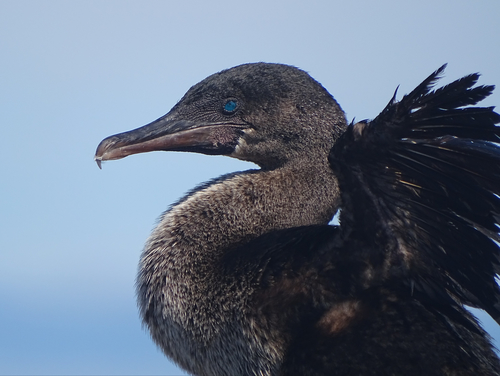
Description: The flightless cormorant is the largest living member of the cormorant family. It measures 89–100 cm (35–39.5 in) in length and weighs 2.5–5.0 kg (5.5–11.0 lb). Its wings are only about one-third the size needed for a bird of its build to fly, and the keel on its breastbone (where flight muscles attach) is also significantly reduced.
Like all cormorants, it has webbed feet and sturdy legs that propel it through water while hunting. Its prey includes fish, small octopuses, and other small marine creatures, and it feeds near the seafloor no more than 200 metres offshore.
It looks slightly similar to a duck, except for its short, stubby wings. Its upperparts are blackish, and its underparts are brown. It has a long beak hooked at the tip and a turquoise eye. Like all cormorants, all four of its toes are connected by webbed skin. Males and females look similar, though males are larger and around 35% heavier. Juveniles generally look like adults but are glossy black with a dark eye. Adults make low growling vocalizations.
Like other cormorants, this bird's feathers are not waterproof. After each dive, it spends time drying its small wings in sunlight. Its flight and contour feathers are similar to those of other cormorants, but its body feathers are thicker, softer, denser, and more hair-like. It produces very little oil from its preen gland; air trapped in its dense plumage prevents it from becoming waterlogged.
Distribution and habitat: This unique cormorant is endemic to the Galápagos Islands, Ecuador, with a very restricted range. It is only found on two locations: Fernandina Island, and the northern and western coasts of Isabela Island. Its distribution is tied to the seasonal upwelling of the eastward-flowing Equatorial Undercurrent (also called the Cromwell Current), which brings cold, nutrient-rich water to these western islands of the archipelago.
Its population has experienced severe fluctuations: a 1983 El Niño-Southern Oscillation (ENSO) event reduced the population by 50% to just 400 individuals. The population recovered quickly, however, and an estimate counted 900 individuals by 1999. This species lives on the rocky shores of the volcanic islands it inhabits, and forages in shallow coastal waters including bays and straits.
Flightless cormorants are extremely sedentary: they stay most or all of their lives, and also breed, on local stretches of coastline only several hundred metres long. This sedentary nature has led to genetic differentiation between the main colonies, especially between the Fernandina and Isabela Island populations.
Ecology: Nesting typically occurs between April and October, when sea surface temperatures are coldest. This time of year brings abundant marine food and reduces the risk of heat stress for chicks. During this period, breeding colonies form that hold up to around 12 pairs.
Courtship behavior begins in the sea: the male and female swim around each other with their necks bent into a snake-like shape, then move onto land. The male mostly brings items like seaweed and flotsam (such as rope fragments) to gift to the female, who weaves them into a bulky nest just above the high water mark. The female usually lays three whitish eggs per clutch, though typically only one chick survives. Both males and females share incubation equally.
After the eggs hatch, both parents continue to share brooding duties (protecting chicks from extreme temperatures and predation) and feeding the chicks, though the female brings 40-50% more food items than the male. When chicks reach 70 days old and are close to independence, if food supplies are plentiful, the female will leave the offspring so the male continues parenting, while she re-partners and breeds with a new mate. This means females can raise several broods in a single season, while males cannot, though studies over a decade show environmental conditions with enough food availability for this happen infrequently.
Annual survival for both sexes is around 90%, and maximum longevity is around 13 years. Breeding recruitment is sufficient to maintain a stable population.