About Phainoptila melanoxantha Salvin, 1877
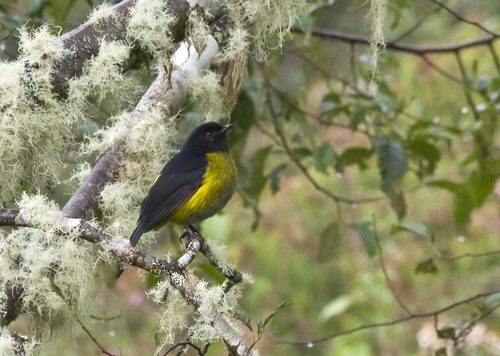
The black-and-yellow phainoptila (scientific name Phainoptila melanoxantha Salvin, 1877) is approximately 20 cm (7.9 in) long, with an average weight of 60 g (2.1 oz). It is a heavy-bodied bird with a broad, rounded tail. Nominate subspecies adult males have black coloring on the head, back, wings, and tail, with a bright yellow rump. Their throat is black, their breast is olive-green, the center of their belly is gray, and the remaining parts of the belly, sides, flanks, and undertail coverts are bright yellow. Adult females have dark gray coloring on the hindneck, face, and throat, which blends through sooty gray to a dark olive-green breast. Juveniles resemble adult females but are duller overall, with a sooty crown, faint dusky streaks on the breast, and olive-green flanks. Males of the subspecies P. m. parkeri have a fully yellow breast, lacking the gray belly center seen in the nominate subspecies, and females have a different breast streak pattern. Both subspecies have a dull red iris, a black bill, and black legs and feet with yellow soles. Regarding distribution and habitat, the P. m. parkeri subspecies occurs in the Tilarán and Guanacaste cordilleras in northern Costa Rica. The nominate subspecies occurs in the Cordillera Central in central Costa Rica, and the Cordillera de Talamanca, which stretches from south-central Costa Rica into western Panama. The two subspecies' ranges are separated by deep river valleys where the black-and-yellow phainoptila does not live. This bird inhabits elfin forest and upper montane evergreen forest in subtropical and temperate zones. Across the species, its elevation range is 1,200 to 3,000 m (3,900 to 9,800 ft). P. m. parkeri occurs starting at 1,200 m (3,900 ft), while the nominate subspecies occurs from 1,800 m (5,900 ft) up to the timber line.