About Phaethornis syrmatophorus Gould, 1852
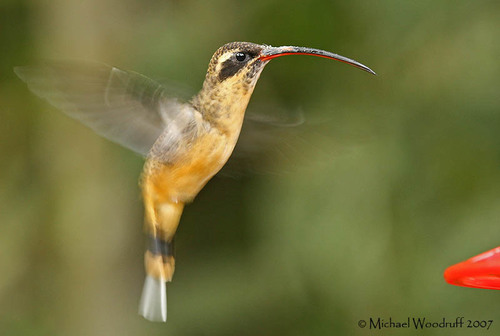
The tawny-bellied hermit (scientific name Phaethornis syrmatophorus Gould, 1852) is a medium-sized hummingbird that reaches approximately 14 cm (5.5 in) in length and weighs between 5 and 7 g (0.18 to 0.25 oz). Its upperparts are olive green. Males have reddish-orange uppertail coverts. For both sexes, the central tail feathers are long and white, while the remaining tail feathers are dark with bright orange tips. The species has two recognized subspecies with differing plumage: the nominate subspecies has orange throat, belly, and undertail coverts, while the throat and chest of P. s. columbianus are dark brown. Both sexes have a clearly decurved bill, and the female's bill is more curved than the male's. The nominate subspecies inhabits the Western Andes of Colombia, including the Cauca and Patía river valleys, and ranges locally south along the western Andean slope through Ecuador to western Loja Province. P. s. columbianus occurs in the Central and Eastern Andes of Colombia, including the southern Magdalena River valley, and extends south along the Andes' eastern slope through Ecuador to the San Martín Department of northern Peru. The species primarily lives in the understory of humid montane forest, and can also be found at forest edges and in dense secondary forest. Its elevation range mostly falls between 1,000 and 2,300 m (3,300 and 7,500 ft), though individuals have been recorded as low as 750 m (2,500 ft) and as high as 3,100 m (10,000 ft). In similar habitats below 1,000 m (3,300 ft), the white-whiskered hermit (P. yaruqui) occurs in place of the tawny-bellied hermit.