About Phaethornis striigularis Gould, 1854
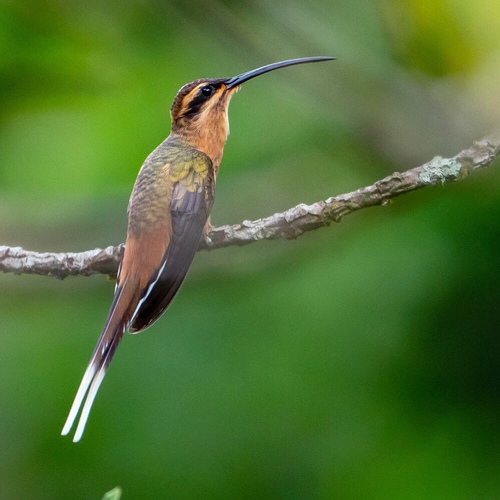
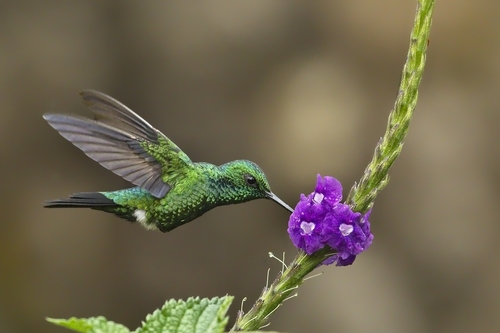
This species is a small hermit hummingbird with a total length of 9–10 cm (3.5–3.9 in) and a weight of 2–3 g (0.071–0.106 oz). Its wing-coverts, mantle, nape, and crown are dull iridescent green; the rump is pale rufous; the belly and flanks are buff; the central underparts and throat are pale greyish brown. The throat has small dark streaks that are often faint and hard to see. It has a blackish "bandit-mask" on the face, bordered above by a whitish-buff supercilium and below by a whitish-buff malar. Its flight-feathers and tail are blackish; the tail is tipped whitish to ochraceous, depending on the subspecies. Like most other hermits, it has a long decurved bill. The basal half of the lower mandible is yellow, and the rest of the bill is black. The sexes are almost identical, while juveniles appear to have entirely pale rufous backs. Males produce a high-pitched, squeaky, monotonous song that is easy to hear, and the exact song structure varies across the species' range. The stripe-throated hermit was often classified as a subspecies of the little hermit (P. longuemareus) alongside several other small hermits, but morphological evidence indicates it may be more closely related to the grey-chinned hermit (P. griseolaris). Currently, most if not all major taxonomic authorities including SACC, the Clements checklist, and the Howard & Moore checklist accept its status as a separate species. It has been proposed that saturatus, a mainly Central American taxon usually treated as a subspecies of P. striigularis, may deserve full species status, which would give it the common name dusky hermit or Boucard's hermit (P. saturatus). Most authorities consider the taxon adolphi a junior synonym of saturatus. The species is distributed across southern Mexico from north-eastern Oaxaca and southern Veracruz east to southern Quintana Roo, Belize, north-eastern Guatemala, northern and eastern Honduras, Nicaragua, Costa Rica, Panama, western, central, and northern Colombia mainly in Pacific lowlands and the Magdalena valley region, western Ecuador south to El Oro, and north-eastern Venezuela on both slopes of the Andes and the northern mountains. It is essentially a resident species as far as we know, though it may make some local movements. This hummingbird lives in a wide range of wooded habitats including forest, woodland, clearings, thickets, and gardens. It typically occurs in humid regions, but is also found locally in drier deciduous habitats such as those in Ecuador. It is mainly found in lowlands and foothills, and has only exceptionally been recorded up to an altitude of 1,800 m (5,900 ft) above sea level. The stripe-throated hermit feeds on flower nectar via trap-lining. It has also been observed piercing the base of flowers to access nectar that would otherwise be out of reach, and sometimes eats small insects. It typically forages fairly low, only occasionally feeding at canopy level. It is essentially solitary, but males gather in leks to sing and attract females. Its nest is a small cup with a dangling "tail" below it, built from plant material bound together with spiderwebs. The female alone incubates the two eggs, which hatch after 15–16 days. Exact breeding timing varies by region; for example, a dependent fledgling was observed in early March in Ecuador.