About Phaethornis malaris (Nordmann, 1835)
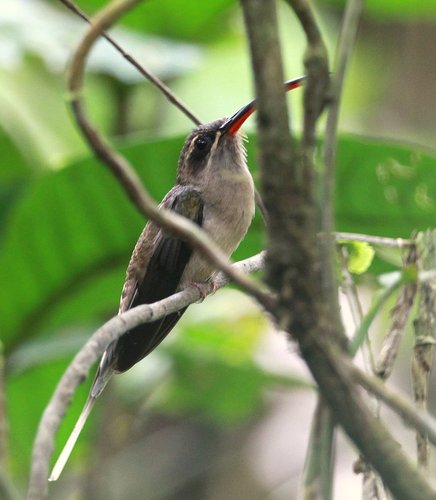
The great-billed hermit (scientific name Phaethornis malaris (Nordmann, 1835)) measures 13 to 17.5 cm (5.1 to 6.9 in) in total length. Males weigh 4.5 to 10 g (0.16 to 0.35 oz), while females weigh 4 to 8 g (0.14 to 0.28 oz). The nominate subspecies is the largest of the recognized subspecies. This species has greenish-brown upperparts and underparts that range from brownish to grayish. Its uppertail coverts feature alternating dark and light ochre bands, and the central tail feathers are long with prominent long white tips. It has a long decurved bill; the female's bill is shorter than the male's, but more curved than the male's.
Each recognized subspecies differs slightly in size or plumage: P. m. insolitus is smaller than the nominate subspecies but otherwise similar in appearance. P. m. moorei has paler, grayer underparts than the nominate. P. m. bolivianus and P. m. margarettae are the smallest subspecies; P. m. bolivianus has a dark brown throat and breast and an orange-ochre belly, while P. m. margarettae is very similar to bolivianus but has paler underparts. P. m. ochraceiventris has a bright orange breast and belly.
The different subspecies of great-billed hermit have distinct ranges: P. m. malaris is found in Suriname, French Guiana, and Amapá state in north-central Brazil. P. m. insolitus occurs in eastern Colombia, southern Venezuela, and the northwestern part of Brazil's Amazonas state. P. m. moorei ranges from eastern and southern Colombia through eastern Ecuador into northeastern Peru, reaching as far as the Marañón River. P. m. ochraceiventris is found in northeastern Peru south of the Marañón River, extending east into western Brazil south of the Amazon River as far as the Madeira River. P. m. bolivianus ranges from southeastern Peru to central Bolivia, and into western Brazil between the Madeira and Tapajós rivers. P. m. margarettae occurs in coastal eastern Brazil from Pernambuco south to Espírito Santo.
All subspecies of great-billed hermit inhabit the understory of a variety of rainforest landscapes, including terra firme forest, foothill tropical forest, higher elevation tropical forest, transitional forest, secondary forest, and bamboo thickets. In addition to these habitats, P. m. ochraceiventris is also found in igapó forest. Across most of the species' range, it occurs below 600 m (2,000 ft) of elevation, but it can be found as high as 1,500 m (4,900 ft) in Colombia and as high as 2,400 m (7,900 ft) in Bolivia.