About Phaethon rubricauda Boddaert, 1783
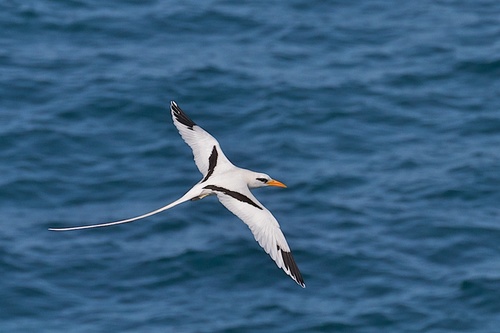
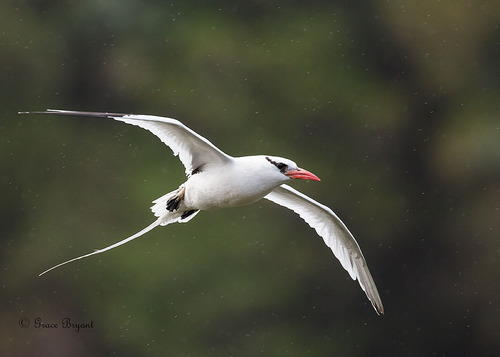
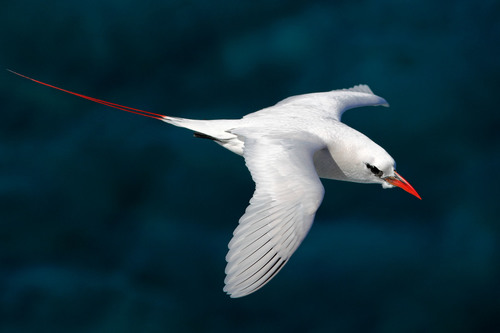
The red-tailed tropicbird (Phaethon rubricauda Boddaert, 1783) has an average total length of 95 to 104 cm (37 to 41 in), which includes 35 cm (14 in) long tail streamers. It weighs around 800 g (30 oz) and has a wingspan of 111 to 119 cm (44 to 47 in). It has a streamlined but solid build, with almost all-white plumage that often carries a pink tinge. Sexes have similar plumage. A dark brown comma-shaped stripe extends back from the lores, through and past the eyes, and reaches the ear coverts. Its iris is dark brown. The bill is bright red, slightly paler at the base and black around the nostrils. The legs and base of the toes are pale blue-mauve, while the webbing and the rest of the toes are black. The white feathers of the head and rump have hidden dark brown bases, while the feathers of the mantle, back, tail rectrices, and tail coverts have dark brown shaft bases. The two long tail streamers are orange or red with white bases that make up roughly one-tenth of their total length, and they can be hard to see when the bird is flying. The white wings have dark chevron-shaped patches on the tertials, and the dark shafts of the primary flight feathers are visible. The pink tinge is often more intense in the remiges of the upper wing. Moulting occurs outside the breeding season, and tail streamers are replaced before the rest of the feathers. Streamers may be replaced at any time, with one streamer growing while the other is shed, and old streamers may be found scattered around breeding colonies. Newly hatched chicks are covered in thin, long, grey-white down that is paler on the head; the lores are bare. Older chicks have greyer down. The primaries, rectrices, and scapulars become visible by the third week of life. Chicks are mostly feathered with residual down on the underparts and under the wings after six weeks, and are fully feathered by 11 weeks. Juvenile birds have a glossy white forehead, chin, throat, and underparts, with prominent black barring and scaling on their crown, nape, mantle, back, rump, and upper wing coverts. Juvenile bills are blackish grey with a light blue-grey base, and their legs and feet are grey. In Australian waters, the red-tailed tropicbird could be mistaken for the silver gull (Chroicocephalus novaehollandiae) or various tern species, but it is larger, heavier-set, and has a wedge-shaped tail. Compared to the adult white-tailed tropicbird, the red-tailed tropicbird is distinguished by its red bill and more fully white wings. Immature red-tailed tropicbirds can be told apart from immature white-tailed tropicbirds by their partly red bills, rather than yellow. The red-tailed tropicbird is generally silent while flying. Outside of courtship displays, birds may give a short greeting squawk to their mate when arriving at or leaving the nest. They produce a low growling call as a defence call, and young birds make a repetitive chattering begging call whenever their parents are nearby. The red-tailed tropicbird ranges across the southern Indian Ocean, and the western and central Pacific Oceans, from the East African coast to Indonesia, the waters around the southern reaches of Japan, across to Chile, and the Hawaiian Islands, where it is more common on the northwestern islands. It occurs in ocean areas with water temperatures from 24 to 30 °C (75 to 86 °F), and salinity under 35% in the southern hemisphere and 33.5% in the northern hemisphere. In the Pacific Ocean, the southern boundary of its range follows the 22 °C (72 °F) summer surface isotherm. The birds disperse widely after breeding. Evidence indicates that birds in the Indian Ocean move westward with prevailing winds; young individuals banded in Sumatra and Sugarloaf Rock, Western Australia, have been recovered at Mauritius and Réunion respectively. Banding data from Kure Atoll shows that birds in the North Pacific disperse in an easterly direction, following the prevailing winds there. Strong winds can occasionally blow the birds inland, which explains sightings away from the coast and their preferred habitats. Johnston Atoll hosts the world's largest colony of red-tailed tropicbirds, with 10,800 nests recorded in 2020. In the Pacific region, it nests on the Australian offshore territories of Norfolk Island and Lord Howe Island, and on Queensland's coral islands, including Raine Island and Lady Elliot Island. In mid-2020, Australian scientists found a bird on Lady Elliot Island that they had banded 23 years earlier as a chick, which had not been seen since, and had returned to the island to breed. Within New Zealand territory, it breeds on the Kermadec Islands. Elsewhere in the Pacific it breeds in Fiji, New Caledonia, French Polynesia, Hawaii (which hosts a large colony on Kure Atoll), the Cook Islands, Pitcairn Island, and islands off the coasts of Japan and Chile. In the Indian Ocean, there are large breeding colonies on Europa, Aldabra, and Christmas Island, with smaller colonies in Madagascar (where it nests on the tiny island of Nosy Ve), the Seychelles, and Mauritius. It also occurs on the Australian territory of Cocos (Keeling) Islands in the Indian Ocean. The warm waters of the Leeuwin Current allow the species to nest at Cape Leeuwin in southwestern Australia, but it is only a rare visitor to New South Wales at corresponding latitudes on Australia's east coast. It also nests at Ashmore Reef and Rottnest Island off Western Australia, as well as Sugarloaf Rock at Cape Naturaliste and Busselton on the Western Australian coastline itself. It is an occasional visitor to Palau, where breeding has been recorded on the Southwest Islands, and it was first recorded from Guam in 1992. It is an uncommon vagrant to mainland New Zealand, where it has been recorded from the northern reaches of the North Island, especially the Three Kings Islands. It is a very rare vagrant to North America, with records from California and Vancouver Island.