About Phaethon aethereus Linnaeus, 1758
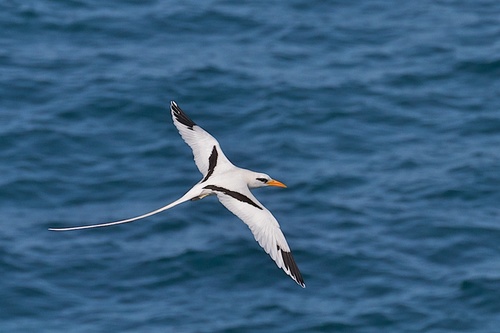
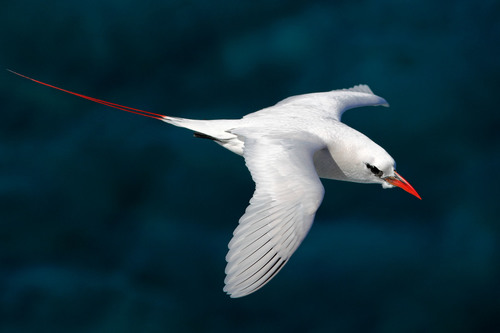
The red-billed tropicbird (scientific name Phaethon aethereus Linnaeus, 1758) has an average total length of 90 to 105 cm (35 to 41 in), which includes its 46 to 56 cm (18 to 22 in) long tail streamers. Without the tail streamers, the bird measures approximately 48 cm (19 in), and its wingspan ranges from 99 to 106 cm (39 to 42 in). Its overall body shape resembles that of a tern. Its plumage is mostly white, with black wing tips, and fine black barring across its back. It has a black facial mask that extends from just above the lores back to the sides of the nape, and gray mottling is typically visible near the nape and hindneck. Black shaft streaks run along the tail and the tail streamers. Its underparts are white, with small amounts of black on the outermost primaries and tertials, and occasional black markings on the flanks. The iris is blackish-brown, and the bill is red. The legs, the base of the central toe, and parts of the outer toes are orange-yellow, while the rest of the feet are black. While both sexes look similar, males are generally larger than females, and their tail streamers are around 12 cm (4.7 in) longer than those of females. Subspecies of the red-billed tropicbird can usually be distinguished by differences in size and plumage. The subspecies Phaethon aethereus mesonauta has a slight rosy tinge when its plumage is fresh, bolder black barring on the upper wing, and more solid black coloration on the outer wing. The subspecies P. a. indicus is smaller in size, has a smaller facial mask that often does not extend far behind the eye, and has a more orange bill with a black cutting edge. When red-billed tropicbird chicks hatch, they are covered in gray down. This down is fully shed around 40 to 50 days after hatching. Young chicks do not have tail streamers. Juvenile red-billed tropicbirds look similar to adults, and have a mostly white crown. In juveniles, the dark stripes above the eye are usually connected at the nape. Their tail feathers typically have black tips or subterminal black dots, and they lack the distinctive tail streamers of adult birds. Juveniles occasionally have black markings on their flanks and undertail coverts. The red-billed tropicbird can be told apart from other tropicbird species by its combination of a red bill and white tail streamers. The slightly smaller red-tailed tropicbird has red tail streamers instead of white. The white-tailed tropicbird is smaller, has a black stripe along its upper wing coverts, and has a yellow-orange bill. Juvenile red-billed tropicbirds have heavier barring on their upper parts than juvenile individuals of other tropicbird species. In flight, adult red-billed tropicbirds can be confused with royal terns, but royal terns have a less direct flight pattern and lack tail streamers. Adult red-billed tropicbirds molt once per year, following a complex basic molt strategy. This prebasic molt finishes before courtship, and lasts between 19 and 29 weeks, with most individuals completing it in 24 weeks. Young birds gain their full adult plumage when they are between two and three years old. Red-billed tropicbirds usually only call near breeding colonies, where groups of 2 to 20 adults circle above the sea and make loud, harsh kreeeee-kreeeee-kri-kri-kri-kr calls. If disturbed at the nest, chicks will give a loud, piercing shriek that is either rasping or reeling. Of the three existing tropicbird species, the red-billed tropicbird has the smallest overall range, but it still occurs across the Neotropics, as well as the tropical Atlantic, eastern Pacific, and Indian oceans. The nominate subspecies Phaethon aethereus aethereus breeds on Atlantic islands located south of the equator, including Ascension Island, Saint Helena on the Mid-Atlantic Ridge, and Fernando de Noronha and the Abrolhos Archipelago in Brazilian waters. It occurs as a vagrant along the coasts of Namibia and South Africa. The subspecies P. a. mesonauta is found in the eastern Atlantic, eastern Pacific, and Caribbean. In the eastern Atlantic, this subspecies was historically restricted to the Cape Verde Islands, but it has colonized the Canary Islands in the 21st century, occurring most commonly on Fuerteventura and also on other islands in the archipelago. P. a. indicus, the Indian Ocean subspecies, is found in waters off Pakistan, western India, southwestern Sri Lanka, the Horn of Africa, and the Arabian Peninsula. This subspecies is a rare but regular vagrant to the Seychelles. Within the West Indies, the species is most common in the Lesser Antilles, the Virgin Islands, and small islands east of Puerto Rico. Breeding in the Western Palearctic occurs on the Cape Verde Islands and the Îles des Madeleines off the coast of Senegal. In 2000, the total number of breeding pairs in this region was probably fewer than 150. In the Pacific Ocean, the species breeds from the Gulf of California and Revillagigedo Islands (Mexico) in the north, south to the Galápagos Islands, Isla Plata (Ecuador), and San Lorenzo Island (Peru). After 15 years of field observations, researchers Larry Spear and David Ainley estimated the minimum Pacific population to be around 15,750 birds in 1995. When not breeding, red-billed tropicbirds disperse over a very wide area; juveniles disperse more widely than adults. Pacific individuals have been recorded as far north as the 45th parallel off Washington State and as far south as the 32nd parallel off Chile. As of 2007, there were 19 records of the species in Hawaii, which is around 4,300 kilometers (2,700 mi) from Mexico. The species sometimes wanders even further: there are five records from Great Britain, and two from Australia (one from October–December 2010 on Lord Howe Island, and one from September 2014 on Ashmore Reef). In July 2005, an individual was found in eastern New Brunswick, Canada, and another has been seen regularly at Matinicus Rock, Maine since 2000.