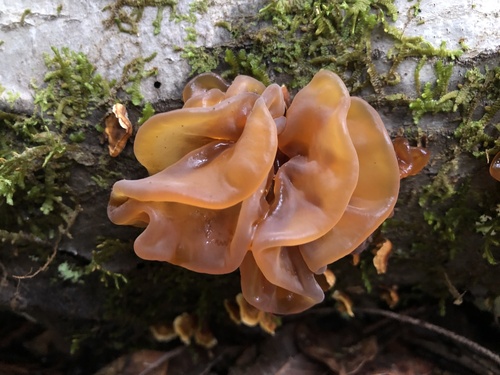
About Phaeotremella frondosa (Fr.) Spirin & Malysheva
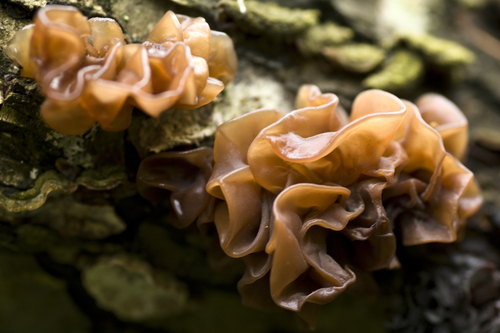
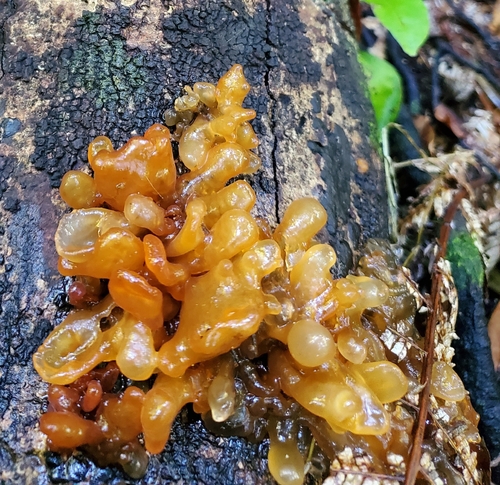
Fruit bodies of Phaeotremella frondosa are gelatinous, ranging in color from pale to dark brown, and can grow up to 7 cm (3 inches) across. They have a seaweed-like appearance, made up of branched, undulating fronds. Under the microscope, the species' hyphae have clamp connections and are embedded in a dense gelatinous matrix. Haustorial cells develop on the hyphae, producing filaments that attach to and penetrate the hyphae of the fungus's host. The basidia are tremelloid, meaning they are globose to ellipsoid with oblique to vertical septa, and measure 13 to 18 by 12 to 16 μm; they are usually unstalked. The basidiospores are subglobose to broadly ellipsoid, smooth, and measure 6.5 to 10.5 by 5 to 9 μm. They germinate either via a hyphal tube or by producing yeast cells. Phaeotremella frondosa is a parasite that grows on the hyphae of Stereum species, including S. hirsutum and S. rugosum. It lives within wood rather than growing directly on the fruit bodies of its host. Following the habitat of its hosts, fruit bodies of P. frondosa are typically found on dead, still attached or recently fallen branches of broadleaf trees. This species has been recorded in North America, Europe, and northern Asia.