About Phaeoptila sordida (Gould, 1859)
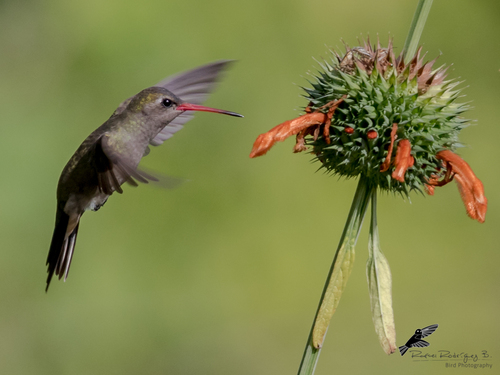
Phaeoptila sordida, commonly called the dusky hummingbird, measures between 9 and 10.6 cm (3.5 to 4.2 inches) long. Males weigh approximately 4.3 g (0.15 oz) while females weigh about 3.4 g (0.12 oz). Males have a bright red bill that ends in a black tip. Their upperparts are bronze green to greenish bronze, with more brownish or grayish coloring on the crown and uppertail coverts. Their tail is dull greenish bronze or grayish brown with a greenish gloss and dusky feather bases. Males have a grayish streak behind the eye and dusky cheeks. Unlike most other hummingbird species, they do not have an iridescent gorget; instead, they have a deep gray throat marked with greenish flecks. Their underparts fade to a slightly lighter gray toward the undertail coverts, which are buffy, and they have distinct white leg tufts. Females share most characteristics with males, but differ in a few key traits: their bill is a duller red with a dark tip, their outer tail feathers have a blackish blue band near the tip and brownish-gray tips, and their underparts are a paler gray. The dusky hummingbird is native to southwestern Mexico, where its range extends from Michoacán and Morelos to Oaxaca. It lives in arid scrub and other semi-open to open landscapes that contain at least some trees. It occurs at elevations between 900 and 2,200 m (3,000 and 7,200 ft).