About Phaeoclavulina abietina (Pers.) Giachini
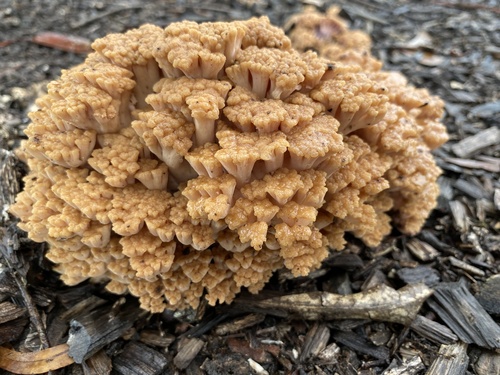
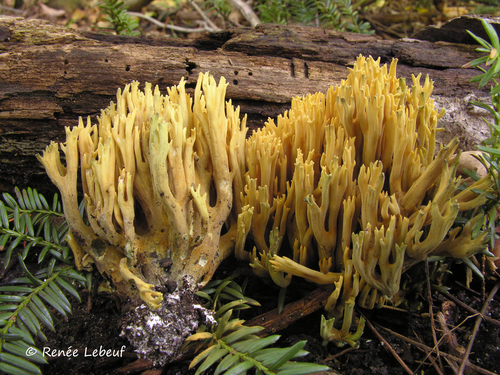
Phaeoclavulina abietina (Pers.) Giachini produces small, leathery fruit bodies that become brittle when dry. Fruit bodies measure 2–5 cm (3⁄4–2 in) tall and 1–5 cm (1⁄2–2 in) wide, branching up to five times from a central stem. The slender branches are slightly flattened or spreading, and are forked or crested near their tips. Fruit bodies range in color from medium yellow green to light olive, and develop a darker olive green to dark olive green bruise when damaged. The central stem is 5–15 mm (1⁄4–5⁄8 in) long and 2–10 mm (1⁄8–3⁄8 in) thick. A mat of mycelia at the stem base attaches to rhizomorphs that branch into the growing substrate. Mushroom tissue has an odor that ranges from indistinct to earthy; its taste is initially sweet, then becomes somewhat bitter. This species is inedible. Spore prints (mass spore collections) are dark orange-yellow. Individual spores are pip-shaped to broadly elliptical with one oblique end, and measure 6–9 by 3.5–4.5 μm. The spore-bearing basidia are typically four-spored, with spores attached via sterigmata up to 7 μm long. Fruit bodies grow scattered, in groups, or sometimes in rows, on the ground in coniferous forest duff. In North America, the species occurs in the United States and Mexico; in the U.S., it is most commonly found from October to February on the West Coast and from July to October inland, including in the Pacific Northwest. It is also found in Europe.