About Phaeochroa cuvierii (Delattre & Bourcier, 1846)
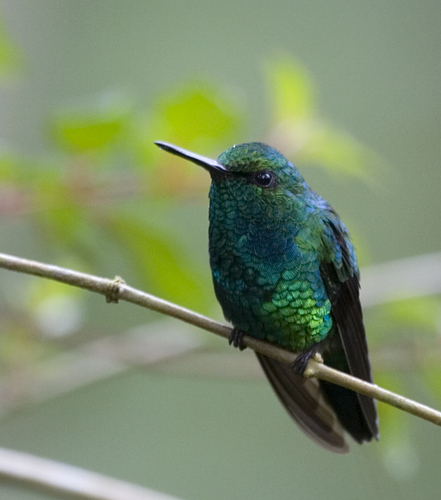
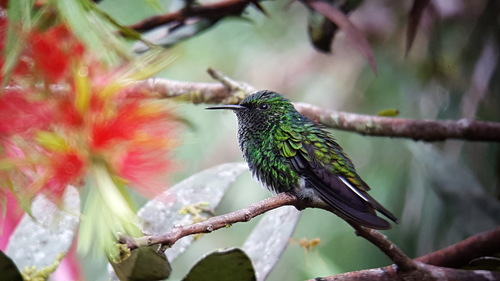
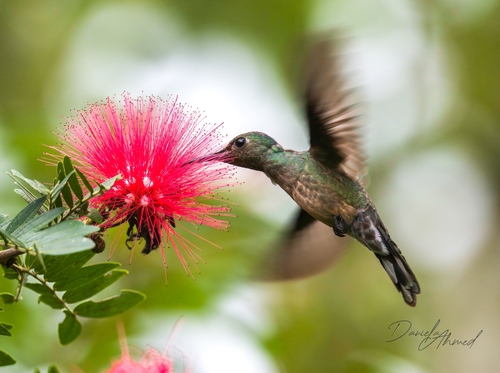
Phaeochroa cuvierii, commonly called the scaly-breasted hummingbird, measures 11.5 to 13 cm (4.5 to 5.1 in) long and weighs approximately 8 to 10 g (0.28 to 0.35 oz). With the exception of the subspecies P. c. roberti, all subspecies have a mostly black bill with a pink base to the lower mandible; P. c. roberti has an entirely black bill. Males and females of all subspecies have identical plumage, though females have a longer bill than males.
The nominate subspecies, P. c. cuvierii, is the smallest and palest subspecies. Its body is mostly bronzy green, with a grayish buff belly. The feathers of its underparts have buffy edges that create a scaly appearance. Its tail is mostly bronzy, with white tips on the outer two or three pairs of feathers. P. c. roberti differs from the nominate subspecies by having black outer tail feathers with white tips. P. c. maculicauda has a greener throat than the nominate, and partially black outer tail feathers. P. c. furvescens has a darker green throat and upper breast, and a paler belly than the nominate. P. c. saturatior is the largest and darkest subspecies, but is otherwise similar to the nominate. P. c. berlepschi has a somewhat rusty belly, and more white on the tail tips than the nominate.
This species has a segmented distribution across its different subspecies: P. c. roberti is found in extreme southeastern Mexico, and along the Caribbean slope through Guatemala, Belize, Honduras, and Nicaragua into northeastern Costa Rica; P. c. maculicauda occurs on the Pacific slope of Costa Rica; P. c. furvescens is found on the Pacific slope of western Panama; P. c. saturatior is limited to Coiba Island off southwestern Panama; P. c. cuvierii ranges from central Panama east into Guna Yala; and P. c. berlepschi is found in the Atlántico and Bolívar departments of northern Colombia.
The scaly-breasted hummingbird lives in a range of semi-open to open landscapes, including dry forest, edges and clearings of gallery and humid forest, mangroves, secondary forest, scrublands, and gardens. It avoids the interior of closed-canopy forest. It most commonly occurs from the understory to the mid-strata of vegetation, but can also be found in the canopy at forest edges. It is mainly found at low elevations, but occurs locally up to 1,200 m (3,900 ft) in Costa Rica.