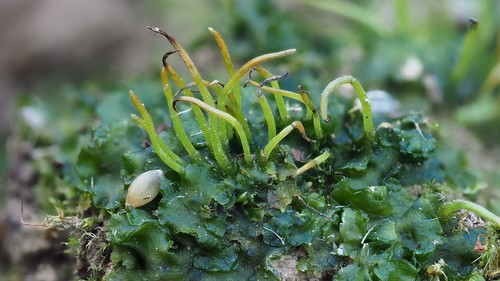
About Phaeoceros carolinianus (Michx.) Prosk.
Phaeoceros carolinianus (Michx.) Prosk. is a hornwort that forms flat, dark green, rosette-shaped patches on the ground. Its plant body has two main parts: the gametophyte, which is the main vegetative body, and the sporophyte, which is the reproductive structure. The gametophyte is a flattened, branching thallus that grows 10–20 mm long and 5–10 mm wide. The thallus has a smooth margin and does not produce specialized reproductive structures called gemmae. A distinctive cellular trait of this species is that each cell contains a single large chloroplast with a central pyrenoid, a protein structure involved in carbon fixation. On its underside, the thallus produces two types of root-like rhizoids: smooth, transparent ones and pale brown tuberculate (warty) ones. The thallus hosts colonies of the cyanobacterium Nostoc, which are visible as dark spots on its lower surface. These cyanobacterial colonies are housed in mucilage-filled cavities within the thallus tissue. P. carolinianus has several distinctive cellular traits: each cell is monoplastidic, meaning it holds a single large chloroplast with a pyrenoid-based carbon-concentrating mechanism, a feature that separates it from most other land plants. The chloroplast contains extensive grana stacks and channel thylakoids. The cytoplasm holds typical plant cell organelles including mitochondria, Golgi bodies, and an endoplasmic reticulum network that extends throughout the cell. Thallus cells are connected by plasmodesmata, which allow intercellular communication. Compared to vascular plants, the thallus has limited tissue differentiation, but it includes specialized regions: photosynthetic tissue, and regions colonized by symbiotic cyanobacteria that appear as scattered dark spots on the lower surface. This species is distinguished by its sporophyte, a horn-like structure that grows vertically from the thallus. These structures reach 40–60 mm in height, and spores develop progressively from the base to the tip of each sporophyte. Each sporophyte consists of a foot anchored in parent gametophyte tissue, and an elongated, spore-producing capsule. The capsule wall has small pores called stomata, with layers of photosynthetic tissue beneath the surface. When mature, the capsule splits lengthwise into two parts to release bright yellow spores. Reported spore diameter measurements range from 32.5–42.3 μm to 42–47 μm, reaching up to 49 μm. Spines on the spore surface are about 2 μm long at the center and 0.5 μm long at the border. Spores have a distinctive surface pattern: the distal face is densely papillate to spinulate, with 17–21 spines across its diameter, while the proximal face is nearly smooth or finely granulate, with only scattered minute papillae in the central area of each face. This spore ornamentation is a key diagnostic feature that separates P. carolinianus from the closely related P. laevis, which has a densely papillate proximal spore surface. Among the spores are sterile branched cells called pseudoelaters, which are pale brown and smooth. The spore wall has a complex six-layered structure. When examined from the inner layer outwards, the structure is: a thin inner layer, a thick loose outer layer, a homogeneous middle layer that forms the surface ornamentations, and three additional outer coating layers of varying thickness. This complex wall structure provides protection and likely facilitates spore dispersal. Unlike some other hornworts, P. carolinianus has an unusually complex spore wall structure that suggests it is relatively evolutionarily advanced within its group. P. carolinianus is monoicous, meaning it produces both male and female reproductive structures on the same individual. Male antheridia mature before female archegonia; each male chamber holds between one and eight antheridia, which turn yellow-orange when mature. The gametophyte shows seasonal variation in growth and reproduction. Sexual organs (antheridia) are produced from September to May. While P. carolinianus can survive as an annual plant in temporary habitats like arable fields, it also forms tuber-like thickenings containing rhizoids on or within the ventral surface of the thallus, which help it survive periods of desiccation. In Britain, sporophytes occur seasonally from September to December. This species has a subcosmopolitan distribution across temperate and tropical regions globally. In the Northern Hemisphere, it occurs from the Mediterranean to northern Europe, across temperate and tropical Asia, and from Canada to Mexico and the Antilles (including Dominica) in North America. In the Southern Hemisphere, it has been recorded in Australia, New Zealand, multiple regions of Africa, and South America including Colombia, Peru, Brazil, Chile, Bolivia, and Argentina. In Australia, it occurs across all Australian states including the Australian Capital Territory, New South Wales, Queensland, South Australia, Tasmania, Victoria, and Western Australia, as well as Lord Howe Island and Norfolk Island. In Southeast Europe, the species was historically sparsely documented. It was recorded in Central Croatia in 2018, growing on open ground alongside other hornworts. Outside of Croatia, it has been documented in Romania, where it is considered critically endangered, Slovenia, where it is considered data deficient, and Bulgaria, where it is also listed as data deficient. In the United States, the species is well-documented in Missouri, where it has been reported from 27 counties, making it the most frequently recorded hornwort species in the state. Its presence has been confirmed across diverse regions of Missouri, with verified specimens collected from the early 1900s to the present. Despite considerable morphological variation across its range, the species retains consistent defining characteristics, especially its monoicous condition and distinctive spore ornamentation. Phaeoceros carolinianus grows on bare soil, forming fans, rosettes, patches or mats that adhere to its substrate. It prefers fresh to moist, sandy-loamy or sandy neutral to slightly acidic soils, and can grow in conditions ranging from full light to full shade. It occurs in both natural and human-created habitats. In natural settings, it grows along bush tracks, roadsides, and waterway banks, especially in damp, shaded areas. In Bolivia, it colonizes wet soil and water-seeping rock slopes at around 1,626 m elevation, forming rosettes 2–4 cm in diameter. In Dominica, it has been recorded on shaded earth slopes at 600 m elevation. In agricultural landscapes, it is most commonly associated with cultivated stubble fields after harvest, and less frequently found in other crops such as corn, vegetables, or fallow fields. It also colonizes field margins, forest edges, ditches, path edges, and pond margins. In Switzerland, it occurs from colline to montane elevations (200–1,080 m), primarily in agricultural areas of the Central Plateau, Jura, and Southern Alps; despite abundant spore production, its populations typically remain relatively small and stable compared to other hornwort species. It is frequently found with other bryophytes in the plant community Riccio glaucae-Anthocerotetum, particularly in areas with temporary dry loamy soils. In Central Europe, it typically acts as an annual species; it is frost-sensitive and develops from summer to autumn, though it may persist longer in sites that hold enough moisture for continuous growth. In temperate regions, P. carolinianus typically follows an annual life cycle, though it can persist as a facultative perennial in some regions such as the southern Appalachians. Under field conditions, gametophytes have a mean growth rate of 0.1 mm per day, which allows them to reach diameters of 20–30 mm over a three-month growing season. Individual plants can survive and grow for up to 18 months under favorable conditions. Sexual reproduction begins weeks after germination, as male and female reproductive structures develop on the same monoicous plant. Male antheridia mature before female archegonia. Sporophytes emerge 3–4 weeks after germination, once plants reach a minimum diameter of 3 mm. Each plant typically produces between 4.5 and 23 sporophytes over one growing season, with spores maturing progressively from the base to the tip of each capsule. Phaeoceros carolinianus has been developed as a genetically tractable experimental system, with successful Agrobacterium-mediated genetic transformation achieved in 2023. The species can be maintained in axenic (sterile) culture on KNOP medium, and propagated vegetatively with monthly subculturing. Its simple thallus morphology and relatively flat growth make it useful for cellular imaging studies, particularly for investigating fundamental aspects of plant cell biology such as cell polarity, plasmodesmata-related processes, and cell division. Several traits make P. carolinianus particularly valuable for studying plant evolution and development. Its single chloroplast per monoplastidic cell, with a pyrenoid-based carbon-concentrating mechanism, is unique among land plants, and offers insights into the evolution of photosynthetic systems. The species also forms symbiotic relationships with cyanobacteria, providing opportunities to study relatively rare plant-microbe interactions among land plants. The development of genetic transformation techniques for this species has enabled the use of fluorescent proteins to study cellular structures and processes, including the visualization of organelles such as mitochondria, chloroplasts, and the endoplasmic reticulum.

