About Phaenostictus mcleannani (Lawrence, 1860)
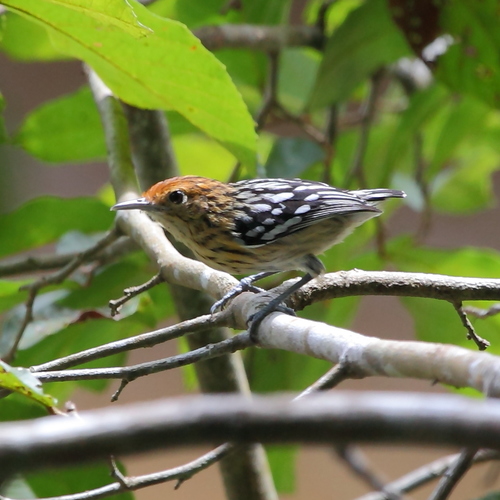
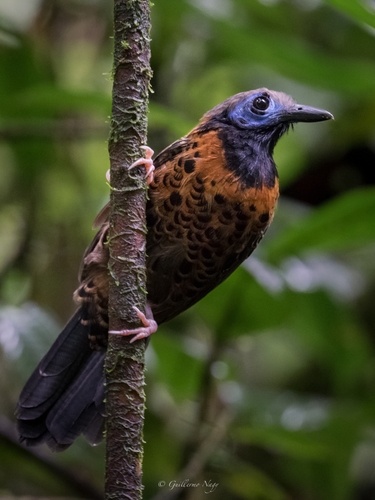
The ocellated antbird (Phaenostictus mcleannani) is a moderately large antbird with a long bill and long tail. It measures 17.5 to 20 centimeters (6.9 to 7.9 inches) in length and weighs approximately 50 grams (1.8 ounces). Females are typically slightly smaller and lighter in weight than males. This species follows Bergmann's rule: birds living closer to the Equator have smaller wings and bills than those living further from the Equator. Aside from small size differences, males and females have identical plumage, and there is very little variation across the species' recognized subspecies. Adult ocellated antbirds have a brown-gray crown, a rufous-brown nape, bright blue bare skin surrounding the eye, and black cheeks and throat. Their back feathers and wing coverts are black with narrow rufous-brown edges, which create a scaly patterned appearance. The rump is a plain greenish brown, the flight feathers are plain dark brown, and the tail is black. The breast is plain rufous-brown, matching the color of the nape. The belly feathers are black with wider rufous-brown edges than those found on the back feathers, and the vent area is reddish brown. Immature birds are similar in appearance to adults, but have a darker cap and a less sharp, clear pattern on the back and belly. The ocellated antbird's distribution extends from Honduras south to Ecuador. The northernmost subspecies, P. m. saturatus, occurs from northern and eastern Honduras south through Nicaragua, along the Caribbean slope of Costa Rica, and into Bocas del Toro Province in far western Panama. The nominate subspecies is found from central and eastern Panama into northwestern and western Colombia, reaching as far south as Valle del Cauca Department. P. m. pacificus ranges from far southwestern Colombia into Esmeraldas Province in northwestern Ecuador. This bird lives in lowland and foothill evergreen forest. It strongly prefers old-growth primary forest, but can also be found in mature secondary forest. It almost always stays within the forest undergrowth. Across most of its Central American range, it occurs at elevations up to 1,250 meters (4,100 feet), though it only reaches 1,200 meters (3,900 feet) in Costa Rica. In Colombia, it is found below 900 meters (3,000 feet). In Ecuador, it mostly lives below 400 meters (1,300 feet), but can locally reach elevations of 700 meters (2,300 feet).