About Phacochoerus africanus (Gmelin, 1788)
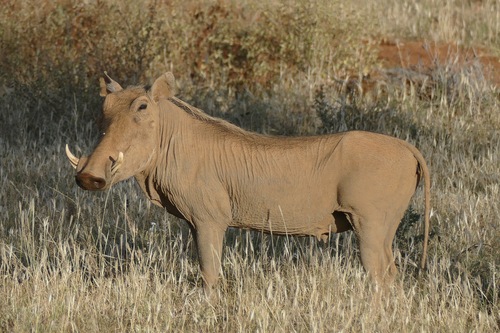
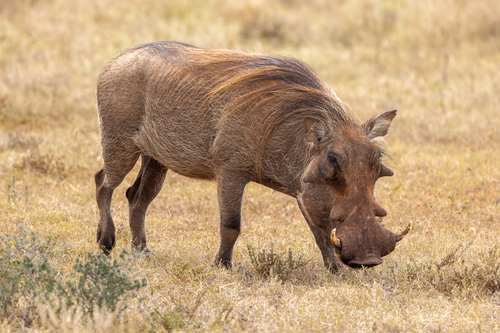
The common warthog, scientifically named Phacochoerus africanus, is a medium-sized species. It has a head-and-body length from 0.9 to 1.5 meters (2 feet 11 inches to 4 feet 11 inches), and a shoulder height from 63.5 to 85 centimeters (25.0 to 33.5 inches). Females weigh 45 to 75 kilograms (99 to 165 pounds), making them smaller and lighter than males, which weigh 60 to 150 kilograms (130 to 330 pounds). This species is identifiable by two pairs of tusks that protrude from the mouth and curve upwards. The lower pair of tusks is far shorter than the upper pair, and becomes razor-sharp when it rubs against the upper tusks every time the warthog opens and closes its mouth. Upper canine teeth (upper tusks) can grow to 25.5 centimeters (10.0 inches) long, with a wide elliptical cross section that is roughly 4.5 centimeters (1.8 inches) deep and 2.5 centimeters (0.98 inches) wide. A tusk curves 90 degrees or more from its root, and will not lie flat on a flat surface because it curves somewhat backward as it grows. Tusks are not used for digging; instead, they are used for combat with other warthogs and defense against predators, and the lower tusks can inflict severe wounds. Common warthog ivory is harvested from these constantly growing canine teeth. The tusks, especially the upper set, function much like elephant tusks, with all designs scaled down. Carved warthog tusks are produced predominantly for the tourist trade in eastern and southern Africa. The common warthog has a large head, with a mane running down its spine to the middle of its back. Sparse hair covers its body, which is usually black or brown in color. Its tail is long and ends in a tuft of hair. Common warthogs do not have subcutaneous fat and have a sparse coat, which leaves them susceptible to extreme environmental temperatures. The common warthog is the only pig species that has adapted to grazing and savanna habitats. Its diet is omnivorous, consisting of grasses, roots, berries and other fruits, bark, fungi, insects, eggs, and carrion. Diet varies with the seasons, depending on the availability of different food items. During wet seasons, warthogs graze on short perennial grasses. During dry seasons, they survive by eating bulbs, rhizomes, and nutritious roots. Warthogs are powerful diggers, using both their snouts and feet. When feeding, they often bend their front feet backwards and move around on their wrists. Calloused pads that protect the wrists during this movement form early in fetal development. Although they are capable of digging their own burrows, they often occupy abandoned burrows dug by aardvarks and other animals. Common warthogs commonly reverse into these burrows, keeping their heads facing the burrow opening and ready to exit quickly if needed. To cope with high temperatures, common warthogs will wallow in mud, and to cope with low temperatures, they huddle together. Although common warthogs can fight, with males fighting each other during mating season, their primary defense is to flee via fast sprinting. When threatened, warthogs can reach running speeds of up to 48 km/h (30 mph). They run with their tails held upright, and enter their dens rear-first with their tusks facing outward. The main predators of common warthogs are humans, lions, leopards, cheetahs, crocodiles, wild dogs, and hyenas. Jackals, Verreaux's eagle-owls, and martial eagles sometimes prey on warthog piglets. A female common warthog will defend her piglets aggressively, and common warthogs have occasionally been observed charging and even wounding large predators. They have also been observed allowing banded mongooses and vervet monkeys to groom them to remove ticks. Common warthogs are not territorial; instead, they occupy a shared home range. They live in groups called sounders. Females live in sounders with their young and other females. Females tend to stay in their natal groups, while males leave their natal groups but remain within the overall home range. Subadult males live together in bachelor groups, but adult males live alone. Adult males only join sounders that contain estrous females. Common warthogs have two facial glands: the tusk gland and the sebaceous gland. Individuals of both sexes begin scent-marking around six to seven months old, and males tend to mark more often than females. They mark sleeping areas, feeding areas, and waterholes. Common warthogs use tusk marking during courtship, during antagonistic behaviors, and to establish social status. Common warthogs are seasonal breeders. Rutting begins in the late rainy season or early dry season, and birthing begins near the start of the following rainy season. Their mating system is described as "overlap promiscuity": males have home ranges that overlap the ranges of several females, and female daily behavior is unpredictable. Male boars use two different mating strategies during the rut. With the "staying tactic", a boar stays to defend certain females or a resource that is valuable to females. With the "roaming tactic", boars seek out estrous sows and compete to mate with them. Boars will wait for sows to emerge from their burrows. A dominant boar will displace any other boar that also attempts to court his chosen female. When a sow leaves her den, the boar will attempt to demonstrate his dominance, then follow her before copulation. The staying tactic promotes monogamy, female-defense polygyny, or resource-defense polygyny, while the roaming tactic promotes scramble-competition polygyny. The typical gestation period is five to six months. When they are close to giving birth, sows temporarily leave their family groups to farrow in a separate burrow hole. Litters contain two to eight piglets, with two to four being typical. The sow stays in the burrow for several weeks to nurse her piglets. Common warthog sows have been observed nursing foster piglets if they lose their own litter. This behavior, called allosucking, makes common warthogs cooperative breeders. Allosucking does not appear to be a case of mistaken identity or milk theft, and may be a sign of kin altruism. Piglets begin grazing at about two to three weeks old, and are weaned by six months old. Piglets quickly gain mobility and stay close to their mothers for defense. In the wild, common warthogs live an average of 7 to 11 years, while captive specimens live an average of 21 years.